Key Takeaways
- YouTube is the world's second-largest search engine with over 2.5 billion logged-in users per month (DemandSage, 2026). Search-intent content is the fastest growth strategy for new channels.
- 70% of YouTube watch time comes from the recommendation algorithm, not search — which means SEO and watchability must work together, not in isolation.
- Faceless YouTube channels represent 40% of the platform's top 1,000 channels. AI tools now reduce production time from 7 hours to under 2 hours per video.
- YouTube Shorts drives subscriber growth 41% faster for channels that combine Shorts with long-form content (AIR Media-Tech, 2025).
- The YouTube Partner Program requires 1,000 subscribers and 4,000 watch hours. Most focused-niche channels hit this in 3 to 6 months with consistent posting.
YouTube pays out over $70 billion to creators annually — more than Netflix, HBO, and Disney+ combined (DemandSage, 2026). That figure represents ad revenue, memberships, Super Chats, and shopping. The channel sitting behind most of that payout is not a television studio. It is a single creator with a laptop, a clear niche, and a posting schedule.
This guide maps the complete YouTube growth system for 2026: how the algorithm works, how to get discovered through search, how to produce videos with AI tools, how to build a faceless channel, and how Shorts accelerates growth on new accounts. Every section links to a dedicated deep-dive guide so you can go as deep as the topic requires.
If you are brand new to YouTube, start with the SEO section below. If you already understand YouTube basics and want to scale output with AI, jump to the production and automation sections. If you have zero interest in appearing on camera, the faceless channel section covers the full workflow.
How the YouTube Algorithm Works in 2026
YouTube's algorithm decides who sees your video — and it does not care about your subscriber count. What it cares about is whether viewers watch your video, click it when offered in suggested, and come back to your channel afterward. These three behaviors — watch time, CTR, and return visits — drive the recommendation engine that controls 70% of all watch time on the platform.
In 2026, YouTube runs two separate algorithms: one for long-form content and one for Shorts. Long-form is driven by CTR on thumbnails, average view duration as a percentage of video length, and likes plus shares. Shorts is driven by swipe-away rate in the first 2 seconds, replay rate, and shares to external platforms. The strategies that work for one format do not transfer directly to the other — which is why most guides that treat them as the same thing are useless.
The practical implication: you need a title and thumbnail that gets the click (CTR), a hook that holds attention past the first 30 seconds (watch time), and content specific enough that viewers subscribe because they want to see the next video (return visits). Miss any one of these and the algorithm reduces distribution regardless of how good the rest of the video is.
Citation capsule: 70% of YouTube watch time is driven by the recommendation algorithm rather than search, according to YouTube's own creator documentation. CTR on thumbnails and average view duration are the two highest-weighted signals for long-form content distribution. Shorts uses a separate engine where swipe-away rate in the first 2 seconds is the primary gating signal (VidIQ, 2026).
YouTube SEO — How to Get Found When People Search
YouTube SEO handles the 30% of watch time that comes from search. For new channels with no recommendation history, search traffic is the primary growth engine in months 1 to 6. It is also the most predictable — because search intent is explicit. Someone searching "how to edit YouTube videos on mobile" has told you exactly what they want. Give them that, in the title, description, and video itself, and you rank.
The three highest-leverage SEO moves for new channels are: targeting long-tail keywords (4 to 6 word phrases with specific modifiers), front-loading the primary keyword in the first 50 characters of your title, and writing a description that restates the keyword in the first two sentences. Tags add a small supplementary signal — they matter for categorization, not ranking.
Our YouTube SEO checklist covers all 15 optimization steps in order, from keyword research before filming to analytics review 48 hours after upload. For tag strategy specifically, how to use YouTube tags to get more views covers the data on what actually moves the needle. And for channels starting from zero, how to get views on YouTube with no subscribers covers the discovery mechanics new channels should focus on first.
The free tool stack for YouTube SEO: use the YouTube Keyword Generator for topic research, the YouTube Title Generator for click-worthy titles, the YouTube Title Analyzer to score the strength of your title before publishing, the YouTube Tag Generator for tag lists, and the YouTube Description Generator for search-optimized descriptions.
YouTube Content Production — Scripts, AI, and the Full Workflow
A publishable YouTube video requires five components: a script, a visual layer (footage or screen recording), audio (voiceover or on-camera speech), a thumbnail, and metadata (title, description, tags). In 2026, AI tools handle three of these five without requiring specialized skill or significant time investment.
For the script: ChatGPT writes a structured YouTube script — hook, main points, CTA — in under 30 seconds from a topic description. The average beginner takes 45 to 90 minutes to write the same script manually. Our YouTube script writing guide covers the exact structure: hook format, body pacing, and CTA placement. The YouTube Script Generator applies this structure automatically.
For the complete AI production workflow — ChatGPT for scripting, ElevenLabs for voiceover, CapCut for editing, and Canva for thumbnails — our guide on making a YouTube video with ChatGPT for free covers each step with exact settings, time estimates, and the AI disclosure step YouTube now requires. The full workflow produces a publishable video in under 2 hours. Use the YouTube Video Idea Generator to validate your topic before filming, and the YouTube Thumbnail Downloader to research competitor thumbnails in your niche.
Faceless YouTube Channels — Growing Without Appearing On Camera
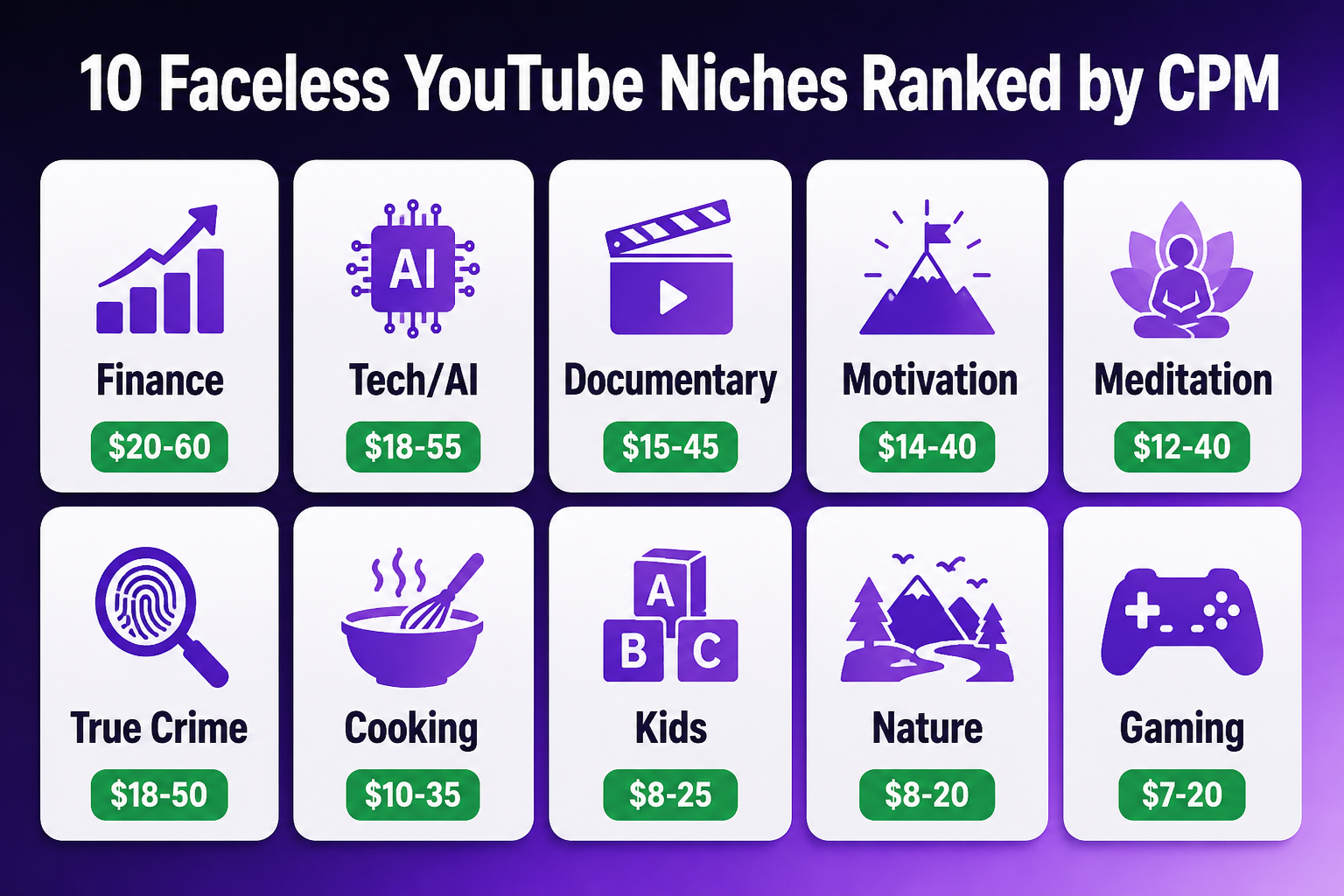
A faceless YouTube channel never shows the creator on screen. The content is delivered through AI voiceover, screen recordings, stock footage, text animations, or documentary-style narration. 40% of YouTube's top 1,000 channels are faceless (OutlierKit, 2025). Finance, technology, health, and documentary-style content are the strongest niches because their CPM rates — how much advertisers pay per 1,000 views — run 3 to 10 times higher than entertainment content.
For niche selection with CPM data, our faceless YouTube channel ideas for introverts ranks 10 niches by CPM so you can choose based on revenue potential, not just personal interest. Finance channels earn $10 to $45 CPM. Technology earns $8 to $25. Gaming earns $2 to $5. The niche you pick determines your revenue ceiling before you post a single video.
For the full build process — channel setup, AI tool stack, production sequence, YouTube AI policy compliance, and monetization timeline — our faceless YouTube channel AI build guide covers every step. For creators who want to run multiple channels at scale using AI-generated content, our YouTube automation guide explains the system-level approach: niche batching, upload scheduling, and the honest monetization timeline.
YouTube Shorts — The Discovery Engine for New Channels
YouTube Shorts generates 70 billion daily views (DemandSage, 2026). For new channels, Shorts is the fastest way to get the first 1,000 subscribers because the Shorts feed exposes your content to non-subscribers by default. Unlike long-form content, where new channels compete with established accounts for recommendation slots, Shorts operates as a separate feed where every video has equal initial distribution.
The Shorts algorithm prioritizes swipe-away rate in the first 2 seconds above all other signals. If a viewer swipes before the 2-second mark, the video is deprioritized immediately. Hooks in Shorts must be faster, more direct, and more visually immediate than long-form hooks. Channels that combine Shorts (for discovery) with long-form content (for monetization) grow 41% faster than single-format channels. Shorts has no ad-share RPM for most creators — the money comes from the long-form content the Shorts drive people to.
Our YouTube Shorts strategy guide covers the seed-and-expand algorithm system, optimal video length by niche, hook writing for the 2-second window, and metadata that drives Shorts discovery. The YouTube Shorts Revenue Calculator helps model realistic income from your Shorts views before you commit a posting schedule.
Free YouTube Tools at CreatorsToolHub
Every tool below is free, requires no account, and produces usable output in under 60 seconds. They are built for the specific tasks that consume the most time in a YouTube production workflow: finding ideas, writing titles, generating scripts, building tags, and calculating revenue.
- YouTube Video Idea Generator — Topic ideas ranked by search demand for your niche
- YouTube Keyword Generator — Low-competition long-tail keywords with real search volume
- YouTube Title Generator — Click-worthy titles optimized for CTR and search
- YouTube Title Analyzer — Score your title's strength before publishing
- YouTube Script Generator — Full scripts with hook, body, and CTA from a topic
- YouTube Description Generator — Search-optimized video descriptions in one click
- YouTube Tag Generator — Complete tag lists for any video topic
- YouTube Tag Extractor — See what tags any YouTube video is using
- YouTube Hashtag Generator — Niche hashtags for improved discoverability
- YouTube Channel Name Generator — Brandable channel name ideas for your niche
- YouTube Thumbnail Downloader — Download competitor thumbnails for research
- YouTube SEO Score Checker — Audit your video's SEO before and after publishing
- YouTube Money Calculator — Estimate channel earnings from views and CPM
- YouTube CPM Calculator — Calculate your effective CPM and RPM rates
- YouTube Engagement Calculator — Benchmark your engagement rate against the platform average
- YouTube Shorts Revenue Calculator — Model Shorts income from view count and niche
Frequently Asked Questions
How long does it take to grow a YouTube channel from zero?
Most channels with a focused niche and consistent 2-to-3-videos-per-week schedule hit 1,000 subscribers (Partner Program threshold) in 3 to 6 months. Channels posting in broad niches without keyword research take 12 to 18 months for the same milestone. The biggest variable is niche specificity: the narrower and more searchable your topic, the faster YouTube's algorithm can match you to the right audience. Starting with search-optimized content in a defined niche compresses the timeline more than any other single decision.
Do you need expensive equipment to start a YouTube channel?
No. The most important equipment decisions are lighting (natural light or a $30 ring light) and audio (a $30 USB microphone or your phone with a clip-on mic). Camera quality matters less than lighting and audio quality. For faceless channels, no camera is needed at all — AI voiceover tools like ElevenLabs and free editors like CapCut produce professional-quality videos at zero hardware cost. Most successful channels in 2026 started with a phone and a quiet room.
How much money can a YouTube channel make?
YouTube ad revenue (RPM) ranges from $1 to $50 per 1,000 views depending on niche, audience location, and video length. Finance, business, and technology channels earn $8 to $30 RPM. Entertainment and gaming channels earn $1 to $5. A channel with 100,000 monthly views in a finance niche earns roughly $800 to $3,000 per month from ads alone. Brand deals typically pay 2 to 5 times the ad revenue for channels above 10,000 subscribers. The YouTube Money Calculator models realistic earnings for your specific niche and view count.
What is the fastest type of YouTube content to rank?
Tutorial and how-to content ranks fastest for new channels because search intent is explicit and evergreen. "How to do X" queries generate consistent monthly search volume and attract viewers with clear intent. These videos also generate higher watch time because viewers follow along with the tutorial. In comparison, trend-based content ranks quickly but decays fast. For a new channel, 80% tutorial content plus 20% trend commentary gives the best balance of sustainable search traffic and algorithm discovery.
What is the YouTube Partner Program (YPP) threshold in 2026?
YouTube Partner Program requires 1,000 subscribers and 4,000 valid public watch hours in the past 12 months for standard ad revenue access. YouTube expanded YPP in 2023 to include a lower tier (500 subscribers, 3,000 watch hours) that unlocks channel memberships and Super Thanks but not ad revenue. Most creators target the 1,000-subscriber threshold because that is where ad revenue — the primary passive income stream — becomes available. The YouTube Engagement Calculator helps track the watch time side of this equation.