YouTube Shorts hit 200 billion daily views in June 2025, up from 70 billion just 15 months earlier — a 186% increase that no other video format has matched in the same period. (Search Engine Journal, citing YouTube CEO Neal Mohan at Cannes Lions, June 2025) That volume means distribution opportunities that simply didn't exist two years ago. A small channel with the right setup can reach 100,000 views on a single Short without an existing audience, without a budget, and without a viral moment — because 74% of Shorts views come from non-subscribers. The channel doesn't get you there. The content does.
Key Takeaways
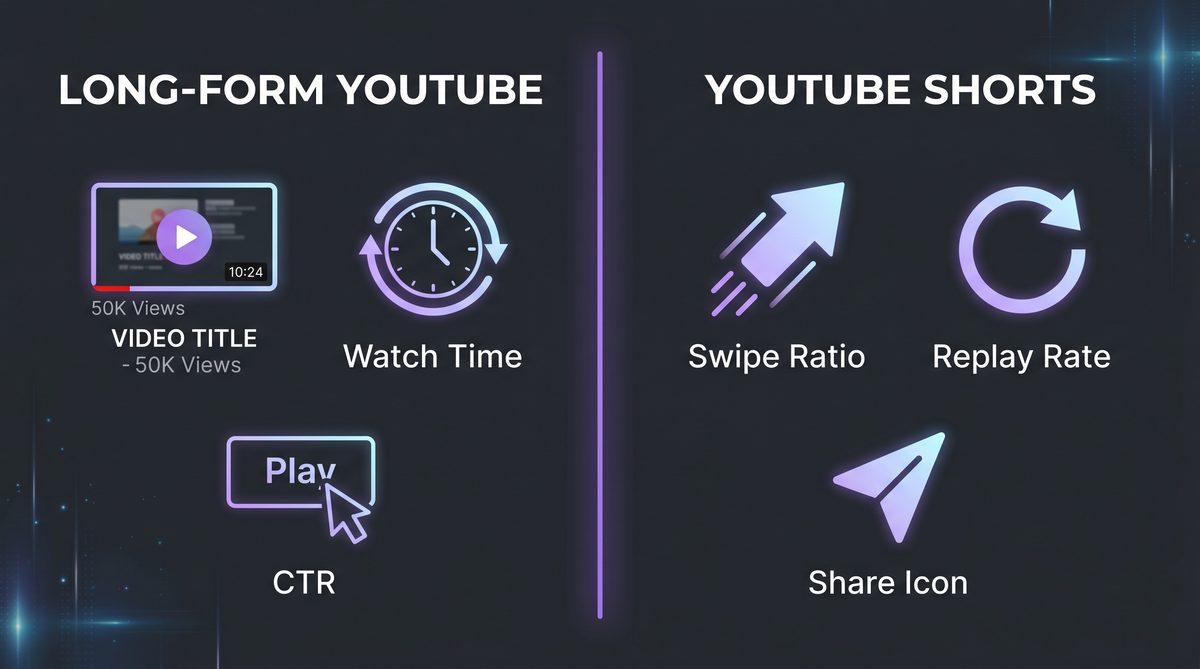
- Shorts run on a completely separate algorithm from long-form YouTube. Watch time, CTR, and subscriber count don't transfer between the two systems.
- Viewers swipe away within 5-6 seconds if not hooked. A compelling hook in the first 2 seconds retains approximately 19% more viewers. (virvid.ai, 2025)
- The 50-60 second range shows the highest average completion rate at 76% — but the 25-35 second range is easiest for new creators to hit consistently. (Shortimize, 2026)
- Shorts views convert to subscribers at 0.8% on average versus 2.3% for long-form. 100K Shorts views yields roughly 800 subscribers, not 2,000. Plan accordingly.
- Full YouTube Partner Program eligibility through Shorts requires 1,000 subscribers and 10 million valid Shorts views in 90 days. (vidIQ, 2026)
Why YouTube Shorts Runs on a Completely Different Algorithm
YouTube confirmed in late 2025 that Shorts and long-form content run on two fully separate recommendation engines with different signal weights. (vidIQ, 2025) This is the most important thing to understand before you post your first Short. Everything you've read about optimizing for long-form YouTube — maximizing click-through rate, boosting average view duration, growing a subscriber base to seed initial views — applies to a completely different system.
The Shorts algorithm's primary signals are: swipe-vs-watch ratio in the first 1-3 seconds, replay rate, and shares. Long-form's primary signals are: CTR on thumbnails, average view duration as a percentage, and session contribution (how much time a video keeps someone on the platform). A 200-subscriber channel with strong Shorts retention signals will outperform a 50,000-subscriber channel with weak ones. The systems don't talk to each other in the ways most creators assume. What you've built on the long-form side doesn't give you a head start on Shorts — and vice versa.
The practical consequence: stop using long-form YouTube's playbook. Shorts has no thumbnails in the feed. Titles matter only for search and suggested — not for the main Shorts feed where most of your views will come from. Subscriber count is not factored into initial distribution. You're starting from the same algorithmic position as a channel with a million subscribers every single time you post a Short.
How the Seed-and-Expand System Decides Who Gets 100K Views
Every Short goes through what YouTube's algorithm team calls an "explore and exploit" mechanism. (vidIQ, 2025) When you post, YouTube serves your Short to a small seed audience — a targeted initial group drawn from users whose watch history matches your content category. If the swipe rate is low and the replay rate is high within that seed, the algorithm commits to broader distribution. If viewers swipe away early, the Short stalls.
Think of it like a short audition in front of 500 people. If enough of them clap, you go to the next stage. If most of them walk out within the first 5 seconds, the show ends. The difference between a Short that stops at 1,200 views and one that hits 100,000 is almost always what happens in that seed audience window — not the quality of the content overall, but whether the opening seconds persuaded enough of that seed group to keep watching.
Retention benchmarks that signal strong seed performance in 2026: 65% or higher for Shorts under 30 seconds, 50% or higher for Shorts between 30 and 60 seconds. (Shortimize, 2026) These are creator-testing benchmarks, not official YouTube figures — but they're the most consistent numbers from channels that have reverse-engineered the distribution threshold. If your Shorts analytics consistently show completion rates below these numbers, the hook and opening structure are the first things to fix, not the length or topic.
How Long Should Your YouTube Shorts Be?
There's no single optimal length — but there is data. A study by Inflow Network analyzing Shorts performance found that 50-60 second clips earn nearly 22 times more views than clips under 10 seconds. (Piktochart, 2026) Shortimize's 2026 retention analysis found that 50-60 second Shorts hit a 76% average completion rate — the highest of any length bracket. (Shortimize, 2026)
However, those numbers come with a condition: the content needs to justify the length. A 55-second Short that has a compelling payoff at the end consistently outperforms a 55-second Short that runs out of ideas at 30 seconds. For new creators, the 25-35 second range is more forgiving — it's long enough to deliver a complete idea, short enough that a viewer who's mildly interested will stick around to the end rather than swiping. The practical recommendation for someone building a Shorts channel from zero: start in the 25-35 second range where you can control completion rate more easily, then test longer Shorts as you understand your specific audience's retention behavior.
One important caveat: 80% of short-video viewers scroll without sound. (Zebracat, 2025) Your Short needs on-screen text or captions to retain that segment regardless of length. A 30-second Short with no text and compelling audio loses a large portion of potential viewers before the hook even lands. Build captions into every Short from the start — not as an afterthought.
The First 2 Seconds: How to Write a Shorts Hook
Viewers decide whether to swipe within 5-6 seconds of a Short starting. (virvid.ai, 2026) A compelling hook in the first 2 seconds retains approximately 19% more viewers through the rest of the Short. (virvid.ai, 2025) Those two facts together define the most important creative constraint in Shorts: your hook isn't the beginning of the video, it IS the video. If you lose viewers in the first 2 seconds, there is no recovery — the seed audience data is already being logged.
The hook formulas that work best on Shorts are similar to TikTok hooks but calibrated for a slightly different swipe behavior. Identity hooks ("If you're a creator with under 1K subscribers..."), outcome-first openers ("Here's how I went from 0 to 100K views in 3 weeks"), and pattern interrupts ("Stop doing this if you want Shorts views") all perform well. For a detailed breakdown of hook types and performance scores from 34,635 videos, the TikTok hook examples guide covers the underlying psychology that applies across all short-form platforms. To generate Shorts-specific hook variations without starting from scratch, the YouTube hook generator produces formatted options for your niche in seconds.
One technique that works specifically for Shorts: the open loop hook. Start with a statement that creates an unresolved question in the viewer's mind — "The reason your Shorts never get above 500 views is this one thing" — and the answer is the content. This structure reduces swipe rate because the viewer feels they haven't gotten what they came for yet. Pair an open-loop hook with your YouTube script to ensure the payoff at the end earns the setup at the beginning. The loop strategy also drives replay rate — if the answer lands at the very end, viewers will watch again to catch what they missed.
Metadata That Drives Shorts Discovery
Shorts titles matter more for search and suggested placement than for the main Shorts feed — but they still move the needle. TunePocket's analysis of 10,000+ viral Shorts found that optimized titles increase CTR by 25-40% and that the most viral Shorts titles average 4-6 words and 20-40 characters. (TunePocket, 2025) Short, specific, and front-loaded with the core promise. "I gained 10K subscribers in 30 days" outperforms "My experience growing my YouTube channel this month." The YouTube title generator can test multiple angle variations before you commit to one.
For hashtags, include #Shorts specifically — it signals to YouTube's classification system that this content belongs in the Shorts feed rather than the main feed. Omitting it can route your Short into the wrong distribution pool. Use 3-5 hashtags total. Stuffing 20+ hashtags doesn't improve reach and can confuse the content classifier. Use the YouTube hashtag generator to find niche-specific tags that complement the required #Shorts tag rather than padding with generic terms.
Trending audio increases reach on Shorts. CapCut's analysis found that Shorts using trending audio within the first 5 seconds see approximately 21% higher reach. (CapCut, 2025-2026) For licensing safety, source audio from YouTube's own Audio Library or YouTube's trending sound feature within the Shorts camera — these are cleared for monetization, unlike commercial tracks that can restrict your video's distribution pool even without triggering a copyright claim. If you plan to join the YouTube Partner Program, start with cleared audio from day one.
Posting Frequency: How Often Small Channels Should Post Shorts
Channels posting 12 or more Shorts per month gain 66% more subscribers and 53% more views than channels posting 1-3 Shorts per month, according to SocialChamp's 2026 analysis. (SocialChamp, 2026) The frequency benefit comes from two mechanisms: more shots at a winning seed audience, and stronger niche signaling that helps YouTube's classification system understand what content category to put you in.
For small channels starting out, 3-5 Shorts per week is a realistic target that captures most of the frequency benefit without sacrificing hook quality. Five well-executed Shorts per week with strong hooks beats daily posting with weak openings. Consistency in topic matters as much as posting frequency — YouTube's classification system builds a model of what your channel is about based on patterns across multiple Shorts. A channel that consistently posts about budgeting will see its content routed to an increasingly accurate seed audience over time, which means higher seed completion rates and faster distribution.
The Shorts algorithm comparison to TikTok's FYP distribution is instructive here. Just like TikTok's For You Page, YouTube's Shorts feed seeds to cold audiences first and uses engagement signals from that cold group to decide on broader reach. The platform-specific difference: YouTube's Shorts algorithm places higher weight on completions and replays, while TikTok weights shares and comments more heavily. Design your Shorts specifically for completion and replay — not just hook strength.
What Actually Happens After 100K Views
The expectation gap here is significant and worth addressing directly. Shorts views convert to subscribers at roughly 0.8% on average, compared to 2.3% for long-form content. (AutoFaceless, 2026) A Short with 100,000 views yields approximately 800 new subscribers in practice — not the 2,000-plus that creators often assume. The 100K milestone is a distribution achievement, not a subscriber acquisition event.
This isn't a reason to avoid Shorts — it's a reason to use Shorts strategically. The channels that grow fastest use Shorts as a top-of-funnel awareness channel and convert that audience with long-form content. Channels combining Shorts and long-form together grow 41% faster than single-format channels. (AutoFaceless, 2026) The Shorts draw the non-subscriber audience (74% of Shorts views are from people who don't follow you). The long-form converts them into subscribers who have a reason to stay.
The tactics that drive Shorts-to-long-form conversion: end your Shorts with a verbal CTA to the long-form video ("full breakdown on my channel"), pin a comment immediately after posting that links to your most relevant long-form video, and structure your Short as a deliberate teaser that leaves out a key piece the long-form delivers. For context on how Shorts compares to Instagram Reels' algorithm in terms of signal weighting, the Instagram Reels algorithm breakdown covers where the two platforms diverge — which matters when planning a cross-platform short-form strategy.
The Path to Monetization Through Shorts
YouTube has two monetization tiers relevant to Shorts creators. The early access tier requires 500 subscribers, 3 public videos, and 3 million valid Shorts views in 90 days — this unlocks fan funding features like Super Thanks and channel memberships. (TubeBuddy, 2026) The full YouTube Partner Program Shorts path requires 1,000 subscribers and 10 million valid Shorts views in 90 days — this unlocks ad revenue sharing. (vidIQ, 2026)
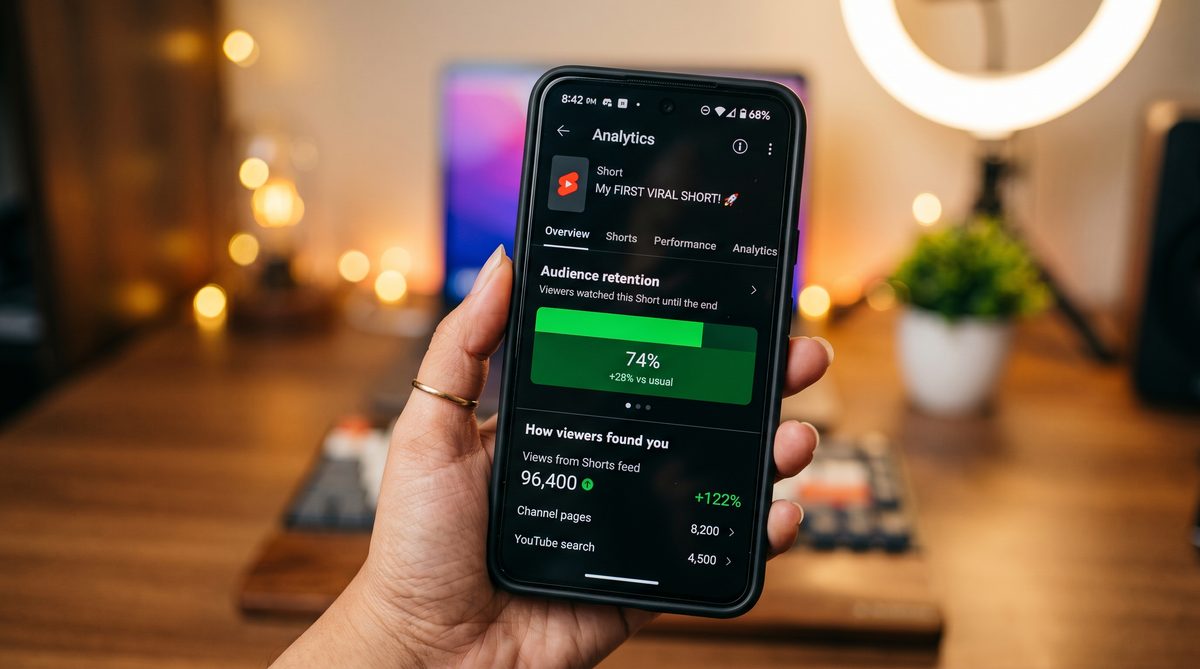
The comparison that matters for planning: the traditional long-form YPP path requires 4,000 watch hours over 12 months. The Shorts path has no 12-month cap — which means a single breakout Short can compress the timeline dramatically. "Valid Shorts views" are specifically views that came from the Shorts feed — views from search, your channel page, or external shares don't count toward the 10 million threshold. This reinforces why feed-sourced views (tracked in YouTube Studio as "Views from Shorts feed") are the metric to watch, not total views.
Make sure every Short's metadata is fully optimized from day one — use the YouTube description generator to ensure description keywords feed into Shorts search indexing, even though descriptions aren't visible in the main Shorts feed. Search-sourced views don't count toward the YPP threshold, but they do build overall channel authority and drive long-form discovery simultaneously.
Frequently Asked Questions
- How do YouTube Shorts get views if I have no subscribers?
- YouTube's Shorts algorithm seeds your content to a targeted cold audience based on content category — not your subscriber count. 74% of all Shorts views already come from non-subscribers. Your subscriber count has no direct effect on initial distribution. What determines whether your Short expands beyond the seed audience is the completion rate and replay behavior of that first group of cold viewers.
- What is the best length for YouTube Shorts in 2026?
- The 50-60 second range shows the highest average completion rate at 76% (Shortimize, 2026), but only when the content justifies the length. For new creators, 25-35 seconds is more manageable — long enough to deliver a complete idea, short enough that mildly interested viewers complete it. Start in the 25-35 second range, then test longer Shorts as you learn your audience's retention patterns.
- Do hashtags matter on YouTube Shorts?
- Yes, but not for the main Shorts feed. Hashtags affect search and suggested placement. Include #Shorts specifically — it signals to YouTube's classification system that this content belongs in the Shorts feed. Use 3-5 total hashtags. Stuffing 20+ hashtags doesn't improve reach and can confuse the classifier. Niche-specific hashtags help YouTube route your Short to a more accurate seed audience.
- How many Shorts views do I need to get monetized on YouTube?
- YouTube's Shorts monetization path requires 1,000 subscribers and 10 million valid Shorts views in any 90-day window for full YPP ad revenue sharing. An early access tier unlocks fan funding at 500 subscribers and 3 million valid Shorts views in 90 days. Valid Shorts views are views that came from the Shorts feed — not from search or your channel page.
- Should I use YouTube Shorts or long-form to grow my channel?
- Both, deliberately. Shorts views convert to subscribers at 0.8% versus 2.3% for long-form — so Shorts alone are inefficient for subscriber growth. Channels combining both formats grow 41% faster than single-format channels. Use Shorts to reach cold audiences (74% of Shorts viewers are non-subscribers), then convert that awareness through end-frame CTAs and pinned comment links to long-form videos.
The math on YouTube Shorts is clear: 200 billion daily views, 74% going to non-subscribers, and an algorithm that distributes based on content quality rather than channel size. A small channel with strong hooks, consistent posting, and a clear niche has every structural advantage available. The bottleneck isn't the platform. It's the first 2 seconds of every Short. Start there — use a YouTube hook generator to build options, write the full script with a YouTube script generator, and use optimized titles and the right hashtags to make sure discovery works as hard as the content itself.