Reels generate 36 times more reach than single-image posts on Instagram, according to Metricool's 2026 study of 39.7 million posts. But that number only holds if the algorithm decides to push your Reel beyond your existing followers. Most don't make it. Understanding exactly how that decision gets made — and when it gets made — is the difference between a Reel that reaches 500 people and one that reaches 50,000.
Key Takeaways
- The Instagram Reels algorithm uses three confirmed signals: watch time completion rate, likes per reach, and DM sends per reach — with sends being the strongest signal for non-follower distribution.
- Every Reel goes through an "audition" with a small non-follower test group before reaching your followers. Weak audition performance caps your distribution permanently for that post.
- Reels under 90 seconds are recommended to non-followers. Longer Reels (3–20 minutes) are surfaced in Explore for sustained watch time.
- Instagram launched Trial Reels in 2026: posts that skip your followers entirely and go straight to a non-follower audience for testing.
- Hashtags no longer support reach or discovery since December 2024. Keywords in captions are now the effective signal.
How the Instagram Reels Algorithm Actually Works
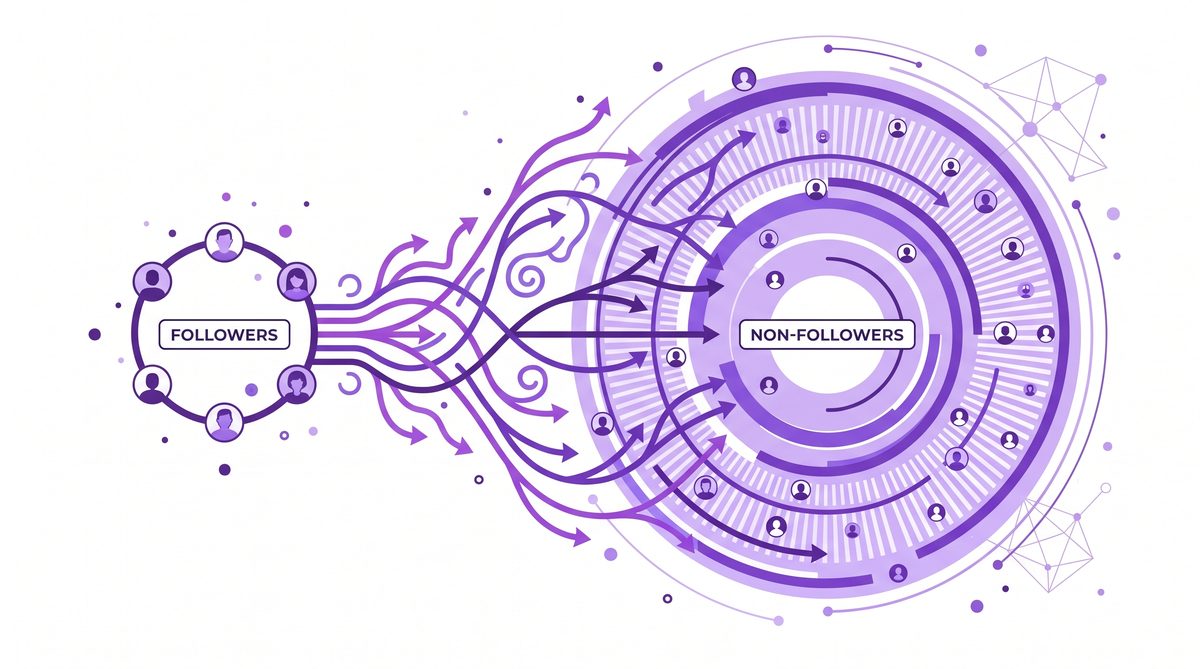
Instagram uses a two-track distribution model for every Reel you post. The first track is your connected audience — your existing followers. The second is the unconnected recommendation system — the non-follower test group that determines whether your content gets pushed to the Explore page, the Reels tab, and suggested posts. Adam Mosseri has confirmed publicly that "Reels are designed to help you discover new things, with an emphasis on entertainment. Much like Explore, the majority of what you see is from accounts you don't follow." (Metricool, May 2026)
That framing matters. Most creators optimize for their followers. But the algorithm is primarily optimizing for people who've never heard of you. The two tracks run in parallel: connected reach and unconnected reach. The unconnected track is where viral growth actually happens — and it's the track that most posts never enter because the audition fails.
Instagram's AI recommendations now account for 94% of content distribution across the platform, according to Dataslayer's analysis of platform behavior. (Dataslayer, Oct 2025) That means organic, non-algorithmic reach — people directly visiting your profile — is nearly irrelevant compared to what the recommendation engine decides to do with your content.
The 3 Signals That Decide If Your Reel Reaches Non-Followers
Adam Mosseri confirmed in January 2025 the three primary signals Instagram uses to rank Reels for non-follower distribution. These aren't speculative — they came directly from Instagram's CEO in a public statement. Understanding them changes how you structure every piece of content you make. (Dataslayer)
Signal 1: Watch Time (Completion Rate, Not Duration)
The algorithm doesn't care how many seconds your Reel is. It measures how much of your Reel the average viewer watches relative to its total length. A 15-second Reel that gets 90% completion beats a 60-second Reel with 40% completion every time. This is why the first 3 seconds of any Reel are worth more than the next 57 combined — they determine whether anyone reaches the end. A strong Instagram hook isn't optional; it's the mechanism that feeds the most weighted signal.
Signal 2: Likes Per Reach
Likes still matter — but only relative to how many people saw the post. A Reel with 50 likes from 100 views is performing dramatically better than one with 500 likes from 50,000 views. The algorithm normalizes for reach, so absolute like counts mean almost nothing in isolation. High likes-per-reach tells Instagram your content resonates with the specific non-follower group being tested.
Signal 3: DM Sends Per Reach (The Strongest Signal)
This is the heaviest signal for non-follower distribution. 694,000 Instagram Reels are sent via DM every minute, according to Metricool's 2025 data. (Dataslayer) When someone sends your Reel to a friend, it tells Instagram your content was worth sharing — the highest-confidence signal that a Reel deserves wider distribution. This is why "send this to someone who needs to see it" outperforms every other call-to-action under the current algorithm.
How the Audition System Works, Step by Step
The audition system is how Instagram decides whether to distribute your Reel beyond your existing followers. It runs in waves — each wave depends on how the previous one performed. If you understand the mechanics, you can optimize specifically for the audition window rather than posting and hoping. (MeetEdgar, Mar 2026)
- Wave 1 — Small non-follower test group. Immediately after posting, your Reel is shown to a sample of non-followers whose interest graph matches your content. This happens before most of your followers even see it.
- Wave 2 — Follower distribution. If the non-follower test performs above threshold on watch time, likes/reach, and sends/reach, the algorithm begins distributing to your existing followers.
- Wave 3 — Expanded non-follower push. Strong follower engagement triggers another round of non-follower distribution, this time to a larger audience. This cycle can repeat multiple times, which is how smaller accounts reach audiences far beyond their follower count.
- Capped distribution. If Wave 1 underperforms, the Reel gets capped. It reaches your followers on a reduced basis and never enters the non-follower recommendation system again — regardless of what you do after the fact.
The critical implication: the first 20 minutes after posting are disproportionately important. Responding to comments, watching engagement velocity, and sharing the Reel yourself during that window can tip the audition result. If you post and immediately put your phone down, you're gambling with the most important window in your Reel's entire lifespan. For more on this, see why your Instagram Reels aren't reaching non-followers.
Reels Tab vs. Explore vs. Feed: How Ranking Differs
Instagram uses different ranking logic across its three main surfaces. Most creator advice treats them as interchangeable — they're not. Each surface serves a different intent and uses different primary signals. (Sprout Social, Jan 2026)
The Reels Tab
Fully discovery-oriented. Ranking is based on DM sends, watch completion rate, and rewatch frequency. Reels under 90 seconds are prioritized here for non-follower distribution. Longer Reels (3–20 minutes) can still appear but primarily reach your existing audience unless sustained watch time triggers Explore eligibility.
Explore
No relationship required for ranking. Instagram evaluates 36 signals per its Meta Transparency Center documentation. The two heaviest: 5-plus-second view duration (active attention, not passive scroll) and predicted 95%+ completion rate. Engagement velocity — speed of likes and comments in the hours after posting — is weighted heavily here. This is where longer-form Reels with strong retention can find large audiences.
The Feed
Driven by your personal social graph, not interest graph. The Feed ranks posts from accounts you already follow based on relationship strength: how often you comment, reply to Stories, and how recently you interacted with that account. A 10-second pause on a post and saves both signal high relevance for Feed ranking. Comments from the poster responding to early comments also lift Feed distribution.
What Instagram Changed in 2026
Several updates in late 2025 and early 2026 directly changed how the algorithm behaves. Creators still using 2024 strategies are working against a different system than the one they studied. Here are the changes that matter most. (MeetEdgar, Buffer, Mar 2026)
Hashtags No Longer Drive Discovery
Instagram removed hashtag following in December 2024. Hashtags are now capped at 5 per post per Instagram's official Creators profile. More critically, hashtags no longer support reach or discovery — they don't push your content into hashtag feeds the way they did in 2023. Keywords in your caption text are now the effective discovery signal. If your Instagram hashtags stopped working, this is the structural reason why.
View Count Redefined
Passive scroll-past no longer counts as a view. Instagram changed its definition: a view only registers when a user actively opens, taps, or intentionally watches content. This makes your view count a more accurate performance signal — and means view velocity is now a stronger proxy for actual audience interest than it was in 2024.
Reels Extended to 20 Minutes
Instagram raised the maximum Reel length to 20 minutes. The algorithm still prioritizes clips under 90 seconds for initial non-follower discovery in the Reels tab. However, longer Reels (3–20 minutes) are now eligible for Explore distribution if they sustain high watch time throughout — opening a new content format for creators who can hold attention.
Trial Reels: Non-Follower Testing Before Publishing
Trial Reels let you post a Reel that goes only to non-followers — completely skipping your existing audience. Instagram describes it as bypassing "the connected ranking system" and going "directly to unconnected recommendations." This is useful for testing hooks, formats, and topics without worrying about how your followers will respond. In February 2026, Mosseri confirmed Trial Reels can now be scheduled in advance.
Same-Day Reels Now Dominate Recommendations
Per Meta's Q1 2026 earnings transcript, same-day posts now make up more than 30% of recommended Reels — double the share from the prior year. (Vidico, Mar 2026) Recency is weighted more heavily than it was even 12 months ago. Evergreen content still performs, but freshness is now a stronger amplifier of distribution than most creators account for.
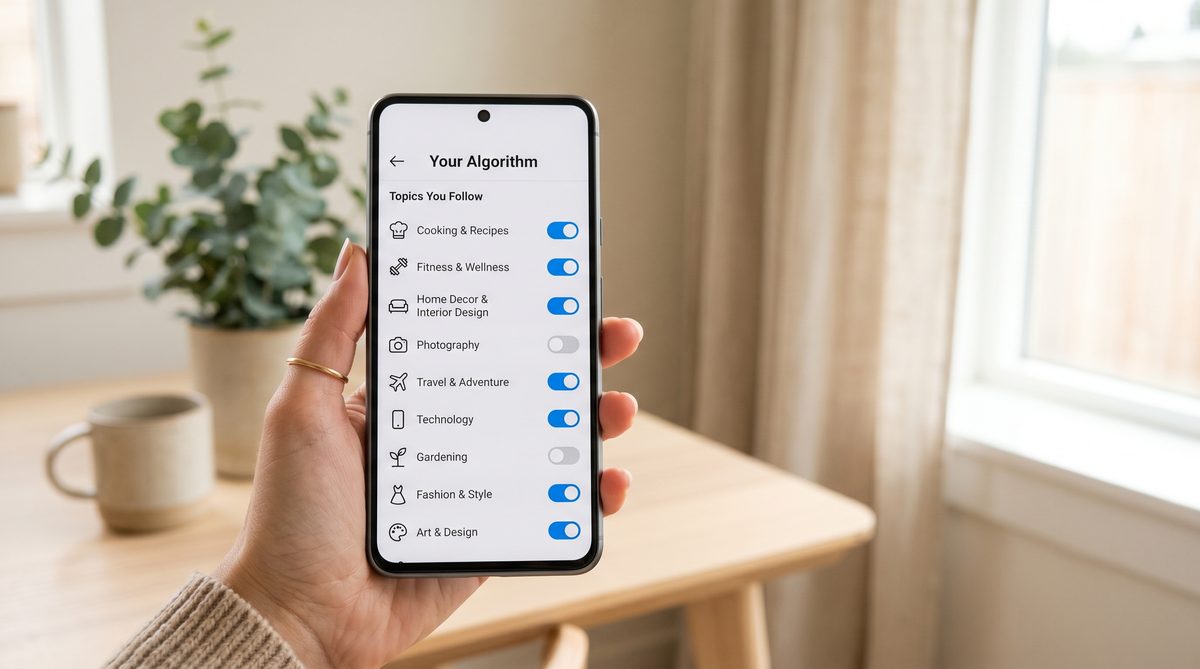
"Your Algorithm" — User-Facing Topic Controls
Instagram launched a feature in December 2025 that lets users see what topics the algorithm has assigned to their account, adjust those topics, and apply changes across Feed, Reels, and Explore simultaneously. From a creator's perspective: your audience is now actively shaping their own interest graph. Content that clearly signals a specific topic — through caption keywords, on-screen text, and audio — is more likely to reach users who've opted into that topic category.
What the Algorithm Does NOT Penalize
There's a lot of misinformation about what hurts your Instagram distribution. Creators change their behavior based on myths, which wastes time and sometimes introduces actual problems. Here's what Instagram has confirmed does not affect your algorithmic reach. (MeetEdgar, Mar 2026)
- Scheduled posts. Using a scheduling tool doesn't reduce your reach. Instagram explicitly confirmed this. The only caveat: third-party apps using unofficial APIs can cause suppression — not because of scheduling, but because of API violations.
- Business vs. creator vs. personal account type. Switching account types doesn't change your algorithmic eligibility. The type of content and engagement you generate determines distribution, not your account category.
- Third-party video editing apps. Editing your Reel in CapCut, Adobe Premiere, or any other app does not affect distribution — as long as you remove competitor watermarks before uploading to Instagram.
- Posting frequency above a certain threshold. More posts do not hurt your per-post reach on their own. Buffer's data from 2.1 million posts found that posting 3–5 times per week yields about 12% more reach per post compared to posting 1–2 times per week, and posting 6–9 times per week yields 18% more. (Buffer, Aug 2025)
What does cause suppression: reposting other creators' content 10 or more times in 30 days, using TikTok-watermarked videos, deploying automation tools that violate Instagram's API terms, and posting content that receives policy violations. If your reach dropped and you're not sure why, see the full breakdown of why Instagram reach drops — it covers each cause with specific recovery timelines.
The Optimal Reels Strategy for 2026
Reels now account for 46% of total time spent on Instagram in the US, and 80% of Reels are watched with sound enabled — meaning audio is a genuine ranking lever, not an afterthought. (Vidico, Mar 2026) Here's how to structure your strategy around what the 2026 algorithm actually rewards.
Reel Length: Match Format to Goal
- Under 60 seconds: best for non-follower reach in the Reels tab. High completion rate potential.
- 60–90 seconds: the sweet spot for Reels tab and Explore. Long enough to deliver value, short enough to hold attention.
- 3–20 minutes: Explore-eligible if watch time stays high. Better for educational content where depth signals authority.
Trending Audio: The 48-Hour Window
Trending audio gives Reels a discovery boost — but only within approximately 48 hours of a sound reaching trending status. After that, market saturation eliminates the advantage. The tactic isn't "use trending sounds." It's "use trending sounds within 48 hours of them trending." (Metricool, May 2026) Check the Reels audio library filtered by "trending" daily if you're using this as a distribution lever.
Caption Keywords Replace Hashtags
Since Instagram removed hashtag following in December 2024, keywords in your caption are now the primary signal Instagram uses to categorize your content and match it to interest-graph audiences. Write captions that naturally include your topic keywords in the first line. A good caption generator can help you structure captions that lead with keywords without sounding forced. If you're still relying heavily on hashtags, use our hashtag generator to find the 5 most relevant non-banned tags rather than stuffing 20+.
Trial Reels for Hook Testing
Before committing to a content format, use Trial Reels to test your hook with non-followers. If the audition data shows strong watch time in the first 3 seconds, roll out that hook format across your regular posts. If it underperforms, you've learned without burning your follower distribution on a weak piece. This is one of the most underused features in the 2026 algorithm toolkit.
How to Use the "Your Algorithm" Feature Strategically
The "Your Algorithm" feature lets users control what topics Instagram shows them. As a creator, this affects you in two ways: your existing audience is shaping their own topic preferences, and Instagram is matching your content to interest graphs based on topic signals in your Reels. (Instagram Official Blog, Dec 2025)
The practical implication: niche consistency is now more important than ever. If you post about cooking one week and fitness the next, Instagram can't reliably categorize your account — which makes it harder to match you to users who've opted into either topic. Accounts that consistently signal one or two clear topic categories get matched more precisely to interested non-follower audiences.
Use on-screen text, spoken keywords in your audio, and caption keywords that all align with the same topic. If you're building a channel around content creation and Instagram growth, every Reel should reinforce those topic signals. If you're starting out and unsure how to structure consistent Reels content, the Instagram Reels guide for beginners with no followers covers the foundational strategy.
Frequently Asked Questions
- How does the Instagram Reels algorithm decide who sees my videos?
- Instagram uses three primary signals confirmed by Adam Mosseri in January 2025: watch time completion rate, likes per reach, and DM sends per reach. Every Reel first goes to a small non-follower test group in an "audition." Strong audition performance triggers wider distribution to your followers and then to a larger non-follower audience in sequential waves.
- What changed in the Instagram algorithm in 2026?
- The biggest changes: hashtags no longer support discovery (removed in December 2024), Reels extended to 20 minutes, Trial Reels can now be scheduled, view counts only register for intentional watching, and Instagram launched the "Your Algorithm" topic control feature in December 2025. Same-day posts now account for over 30% of recommended Reels per Meta's Q1 2026 earnings data.
- What is the best length for Instagram Reels in 2026?
- Under 90 seconds for maximum non-follower reach in the Reels tab. Reels under 60 seconds typically see the highest completion rates. Longer Reels (3–20 minutes) are now eligible for Explore-level distribution if they sustain high watch time throughout, but they primarily reach existing followers without strong audition performance.
- Do hashtags still work for Instagram Reels in 2026?
- No. Instagram removed hashtag following in December 2024 and capped hashtags at 5 per post. They no longer push content into hashtag discovery feeds. Caption keywords are now the effective discovery signal — use them deliberately in your first caption sentence for topic categorization. Use hashtags only for context, not reach.
- Does posting more Reels help with the algorithm?
- Yes, within reason. Buffer's analysis of 2.1 million posts found that posting 3–5 times per week yields 12% more reach per post versus posting 1–2 times weekly. Posting 6–9 times per week yields 18% more. Quality still matters more than volume — a weak Reel that fails its audition trains the algorithm to show your next post to a smaller initial test group.
The Instagram Reels algorithm in 2026 rewards content that gets shared, rewatched, and completed — not content that just gets likes. The audition system means every Reel is competing for non-follower distribution from the first minute it's live. Understanding that mechanic changes everything: how you write your hooks, when you stay near your phone after posting, and how you use Trial Reels to test before committing. If you want help building content that's engineered to pass the audition, start with the hook generator and the caption generator — those are the two pieces of a Reel the algorithm evaluates first.