73% of all TikTok views come directly from the For You tab, according to Metricool's analysis of 2.3 million posts across 92,000 accounts. Not from your followers. Not from shares. Not from profile visits. The For You Page is TikTok's entire discovery engine — and if you're not consistently landing on it, you're effectively invisible on the platform. Here's what the algorithm actually looks at, and what most guides get wrong.
Key Takeaways
- TikTok officially confirms that follower count is NOT a direct factor in FYP recommendations — small accounts can go viral on their first video.
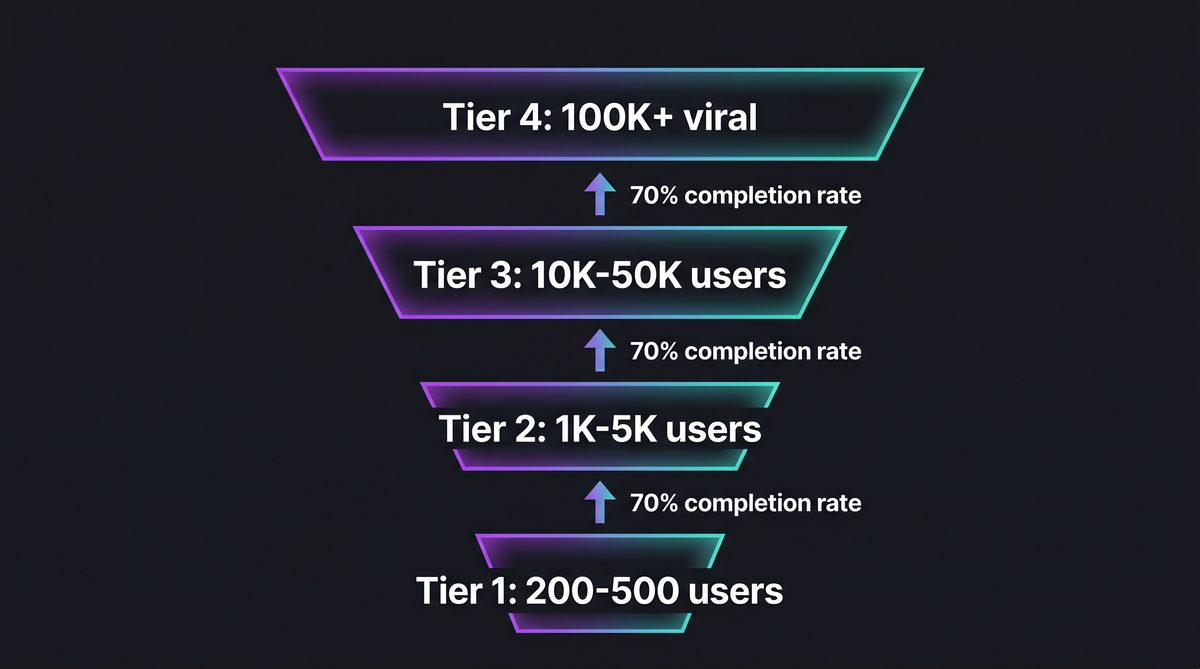
- Completion rate above ~70% is the threshold most associated with advancing to the next distribution tier (Sprout Social, Feb 2026). TikTok tests each video on 200-500 users before deciding whether to expand it.
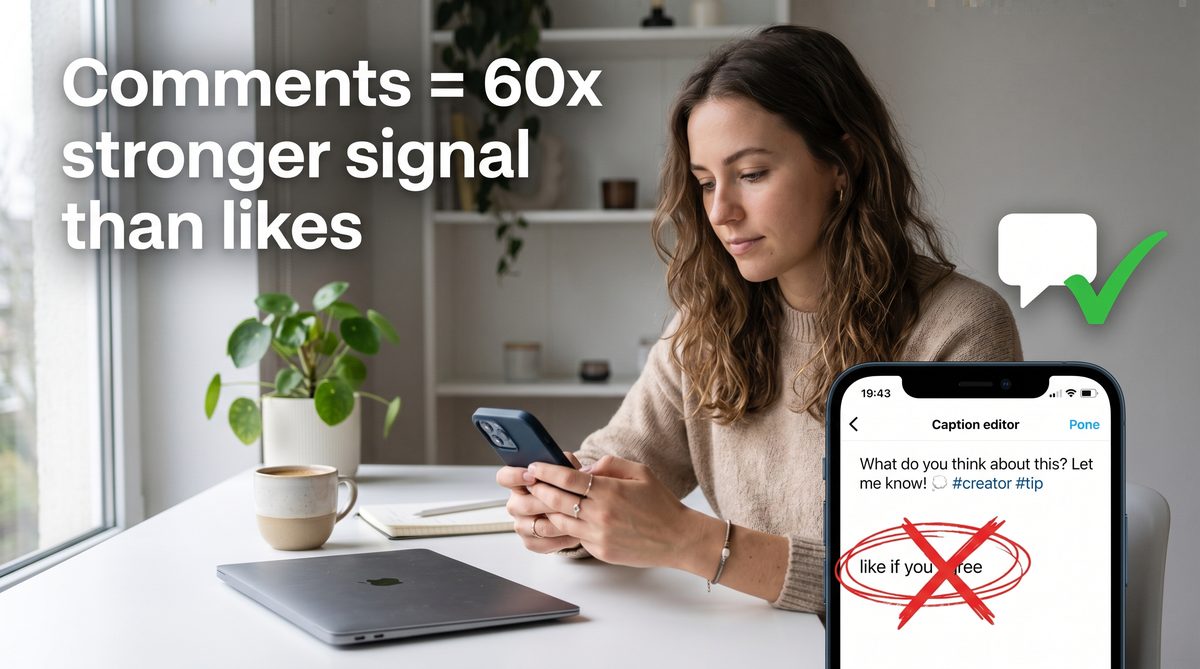
- Asking for likes in your caption REDUCES interactions by 60% — Metricool found this across 2.3M posts. Stop doing it immediately.
- Posting 3-5x per week yields 17-29% more views per post versus daily posting (Buffer, 11M+ posts analyzed).
- 96% of your views and 98% of interactions will happen within the first 10 days after posting. After that window, the video is effectively dead to the algorithm.
How TikTok Decides What Goes on the For You Page
TikTok's official recommendation system documentation outlines three signal categories. (TikTok Newsroom, 2026) User interactions carry the most weight: this includes watch time, completion rate, replays, shares, comments, and whether someone follows you after watching. Video information carries medium weight: captions, sounds, hashtags, and on-screen text used for topic classification. Device and account settings carry the least weight: language preference, country setting, and device type are used as basic filters, not quality signals.
Two things TikTok explicitly states are NOT factors: your follower count and your previous video performance. A brand-new account with zero followers has the same algorithmic starting position as an account with a million. What matters is whether the people who see the video choose to keep watching. That's the only gate.
There is one official restriction that most creators don't know about: TikTok deliberately avoids showing "two videos in a row made with the same sound or by the same creator" to any single user. (TikTok Newsroom) This diversity signal has real implications for posting cadence. If you post three videos in one day, most of your audience will only be shown one of them in any given FYP session. Spacing posts out gives each video a cleaner distribution window.
The Distribution Tier System: How TikTok Tests Your Video
Every video goes through a tiered audience pool system before TikTok commits to broader distribution. The tiers work like this: your video first reaches a test pool of roughly 200-500 users. (SocialBoostDigital, 2026) If the engagement signals from that pool are strong — primarily watch time and completion rate — TikTok pushes it to the next tier of 1,000-5,000. From there, a second strong performance unlocks 10,000-50,000. Viral distribution (100,000+) requires consistently clearing each tier's performance threshold.
The critical number here is completion rate. A drop of more than 30% of viewers in the first 3 seconds tells TikTok the hook failed. Completion rate of approximately 70% or above correlates with the strongest tier advancement signals, based on corroborating data from Sprout Social's algorithm analysis. (Sprout Social, Feb 2026) Note: this is an industry-observed benchmark, not an officially published TikTok threshold. Use it as a directional target.
What this system means practically: you don't need to go viral to get FYP reach. You need to consistently clear Tier 1 and Tier 2. A video with 5,000 views that reached a warm, engaged audience is algorithmically more valuable than one with 500 views and a 15% completion rate. The tier system rewards engagement density, not raw view counts.
What TikTok Counts as a "Qualified View"
TikTok introduced a "Qualified Views" metric that most creators haven't accounted for in their analytics reading. A Qualified View requires the viewer to watch for at least 5 seconds — and only views that came from the FYP count, not views from your profile page, shares, or following feed. (Shortimize, 2025) Your total view count and your qualified view count can differ significantly.
The benchmark for well-optimized creator content is a 50-70% qualification rate: meaning 50-70% of your total views meet the 5-second FYP threshold. If your qualification rate is below 40%, it indicates either weak hooks (viewers exit before 5 seconds) or significant non-FYP traffic (profile visits, direct shares) that isn't feeding back into distribution. Check your Qualified Views in TikTok Analytics under Video Performance — it's a more reliable signal of FYP health than raw view count.
The 8 Engagement Signals That Determine Your FYP Reach
Not all engagement signals are equal. TikTok's weighting hierarchy — derived from Hootsuite's June 2026 analysis of TikTok's own documentation — runs from strongest to weakest as follows. (Hootsuite, Jun 2026) Understanding this hierarchy tells you exactly where to focus your content strategy.
| Signal | Weight | What It Measures |
|---|---|---|
| Watch time / completion rate | Strongest | Did viewers watch the whole thing? |
| Replays / rewatches | Very strong | Was it worth watching twice? |
| Shares | Strong | Did they send it to someone? |
| Comments | Strong | Did it trigger a reaction worth typing? |
| Follows from video | Medium | Did they want more from this creator? |
| Saves / favorites | Medium | Did they want to return to it? |
| Likes | Weak | Passive approval signal |
| "Not interested" / early exit | Suppression | Signals irrelevance — actively reduces reach |
The practical takeaway: likes are the most requested engagement and the least algorithmically valuable. Shares and comments drive distribution far more than a like ever will. Design your videos to trigger a strong reaction, a controversy someone has to respond to, or information someone wants to send to a friend. That's where FYP reach comes from.
Your Hook Is the Only Thing TikTok Sees First
Before TikTok can measure completion rate, saves, or shares, it needs viewers to stay past the first 3 seconds. That's the sole function of your hook — buy time for the rest of the video to accumulate the signals that drive distribution. High-quality creators achieve 72% more watch time per video view and 40x greater follower growth, per TikTok's own internal data cited by Hootsuite. (Hootsuite, Jun 2026) The gap between those creators and everyone else starts at the first frame.
The hook types that drive the highest completion rates — identity hooks, contrarian hooks, curiosity gaps, and outcome-first openers — each work because they give the viewer a specific reason to stay before they've consciously decided to. For a full breakdown with real examples and performance scores from 34,635 videos, see the TikTok hook examples guide. If you want to generate hooks for your specific niche without starting from a blank page, the TikTok hook generator produces typed, categorized options in seconds.
How to Write Captions That Feed the FYP Algorithm
TikTok auto-transcribes your video audio and uses both the transcript and your written caption for content classification. Keyword-rich captions generated approximately 30% more reach and 2x more likes compared to hashtag-heavy captions in 2026, according to Dark Room Agency's analysis. (Dark Room Agency, 2026) The shift in 2025-2026 is toward captions that read like search queries — phrases your target viewer would actually type into TikTok Search. 41% of Gen Z now use social media as a primary search engine, and TikTok's ranking system reflects that. (Sprout Social, Feb 2026)
For hashtags, use 3-5 — no more. Hashtag traffic grew 114% year-over-year in Metricool's study, but stuffing 30+ hashtags has been an active downranking trigger since mid-2025. (Metricool, 2025-2026) The optimal mix: one broad niche tag, one mid-tier topic tag, and one or two ultra-specific niche tags that signal your exact audience to TikTok's classification system. Use the TikTok hashtag generator to find the right tier mix for your specific post topic rather than reusing the same set across every video.
One more caption rule that almost no one follows: do not ask for likes. Posts with questions in the caption generate 26% more comments, which is a far stronger distribution signal. Directly asking for likes reduces interactions by 60% — Metricool measured this across 2.3 million posts. (Metricool, 2025-2026) Replace "like if you agree" with a question that invites a typed response, and you'll get better algorithm signals from fewer total interactions.
The Loop Strategy: Engineering Rewatches Without Asking for Them
Replay rate above a 15-20% threshold is associated with significantly stronger FYP distribution — algorithmically, one viewer watching your video three times is worth more than three viewers watching it once. (SMMNut, 2025-2026) The loop strategy is about engineering that behavior deliberately rather than leaving it to chance.
A loop video ends in a way that flows naturally back into the beginning — either visually (the final frame matches the opening frame) or informationally (the conclusion introduces a question the opening answers). Viewers who reach the end of a loop video and aren't paying close attention will restart it automatically, generating a replay without any conscious decision on their part. For a TikTok script, structure your loop by writing the ending first. Your last line should either complete a circle back to your opening hook or pose a new question that makes the viewer want to rewatch to check if they missed the answer.
Even without a strict loop structure, the principle applies: end your videos with something that makes the viewer stop scrolling. A reveal at the last second, a strong CTA that requires a rewatch to act on, or a surprising final data point. Anything that breaks the passive-scroll momentum at the exact moment TikTok is measuring whether the viewer will share, comment, or move on.
When to Post for Maximum FYP Reach
Sprout Social's analysis of 2 billion engagements across 307,000 TikTok profiles (November 2025 through February 2026) found that Tuesday through Thursday between 2 and 6 PM local time generates the strongest engagement rates. (Sprout Social, Feb 2026) Metricool's separate study of 2.3 million posts identified 6-9 PM globally as peak engagement time, with 8 PM as the single strongest hour. (Metricool, 2025-2026) The two findings are compatible: post in mid-afternoon to catch the early FYP cycle and let the algorithm distribute it into the 6-9 PM peak window.
The 10-day content window matters as much as posting time. 96% of your video views and 98% of interactions happen within the first 10 days after posting. (Metricool, 2025-2026) After day 10, the algorithm essentially stops actively pushing the video. This means your posting strategy should treat each video as a 10-day sprint rather than a long-term asset. Don't wait for a video that stalled on day 3 to "pick up later" — spend your energy on the next post instead.
For posting frequency, Buffer's study of over 11 million TikToks found that 3-5 posts per week yields 17-29% more views per post compared to posting once or twice weekly. Jumping to 11+ posts per week yields 34% more views per post — but risks creative dilution and violates TikTok's own "no two in a row from same creator" diversity signal for individual users. (Buffer, Dec 2025) For most creators, 4-5 posts per week at consistent quality is a more sustainable position than daily posting at declining quality.
What Kills Your FYP Distribution
Negative signals suppress your reach faster than positive signals build it. A cluster of early exits (viewers leaving within 1-2 seconds) in the first 15-30 minutes after posting is the clearest indicator that TikTok will not advance your video beyond Tier 1. The algorithm interprets this as a signal that the hook doesn't match the audience it was served to — and stops serving it. This is why the first audience pool (200-500 users) is so consequential. Your video is effectively being graded in the first half-hour.
Specific behaviors TikTok treats as suppression signals: watching less than 5 seconds (below Qualified View threshold), tapping "Not interested," immediately scrolling away without any interaction, and muting your audio mid-video. These aren't equal in weight — a "Not interested" tap is a stronger negative than a quick swipe — but they compound. A video with high early-exit rates and several "Not interested" signals will be suppressed regardless of how strong your other metrics are later.
30% of TikTok users watch videos on mute, which means missing your audio doesn't automatically mean they scroll away — but it does mean your video needs on-screen text or captions to retain them. (Hootsuite, Jun 2026) TikTok's auto-caption feature is imprecise — generate your own captions and burn them into the video if you're covering anything technical. A viewer who watches with captions is far more likely to reach completion than one who mutes and relies on context clues.
One non-obvious suppression trigger: using copyrighted audio on videos you want to run as ads later. Videos with commercial licensing restrictions are excluded from certain FYP distribution pools. If you're building a catalog that will ever include promoted posts, use TikTok's Commercial Music Library from the start rather than trending commercial sounds. The same content, with a sound swap, can be excluded from significant distribution pools you didn't know you were missing.
Why Small Accounts Can Get on the FYP (And Usually Don't)
TikTok's official documentation is explicit: follower count has no direct effect on FYP recommendations. The reason small accounts don't consistently land on the FYP isn't algorithmic disadvantage — it's the same three issues: weak hooks that can't hold the initial test audience past 5 seconds, captions that don't give TikTok enough context to classify the video correctly, and inconsistent posting that doesn't give the algorithm enough pattern data to understand what niche to place the content in.
The fastest path for a small account is niche specificity. TikTok's content classification system works better with highly specific topic signals. A video about "fitness" is harder to classify than a video about "how many calories you actually burn doing pilates reformer." The second gets served to a smaller but more precisely matched audience pool — and a smaller but matched pool has a much higher completion rate than a large mismatched one. A 75% completion rate from 300 viewers advances your video further than a 25% completion rate from 3,000. That's the counterintuitive math that small accounts miss.
If you're starting from zero, focus on building a content series rather than one-off posts. TikTok's classification system identifies patterns across multiple posts from the same account — the more consistently you signal your niche, the faster TikTok learns who to show you to. For context on how this compares to Instagram's discovery mechanics, see the Instagram Reels algorithm breakdown. The underlying signals differ enough that what works on Reels doesn't always translate to TikTok's FYP, and vice versa.
Frequently Asked Questions
- How do I get on the For You Page with 0 followers?
- TikTok officially confirms that follower count is not a direct ranking factor. Your video will be tested on 200-500 users from TikTok's general pool regardless of whether you have 0 or 100,000 followers. What determines whether it advances to the next distribution tier is the completion rate and engagement quality from that initial test pool — not your account size. Focus on the hook and niche specificity.
- Why am I not getting on the For You Page even though I post every day?
- Daily posting is not a strong FYP signal on its own. Buffer's 11M-post study found 3-5 posts per week outperforms daily posting on a per-post basis. More likely causes: hooks that can't hold viewers past 5 seconds (below Qualified View threshold), captions that don't give TikTok context to classify your niche correctly, or high early-exit rates suppressing your Tier 1 score. Check Qualified View rate in TikTok Analytics first.
- Does using trending sounds help you get on the For You Page?
- Trending sounds give TikTok a topic classification signal and place your video in the sound's discovery pool. This can accelerate Tier 1 exposure. The tradeoff: trending sound pools are saturated, meaning higher competition for the same distribution channel. For most creators, keyword-rich captions and niche-specific content classification are more reliable FYP drivers than chasing trending audio.
- How long does it take to get on the For You Page?
- TikTok pushes videos to the first test pool of 200-500 users within minutes to hours of posting. If that test pool generates strong completion signals, the Tier 2 expansion (1,000-5,000) happens within 24-48 hours. The 10-day window is the practical lifespan of any given video — 96% of its views will accumulate within that period, with the largest spike in the first 48-72 hours.
- Does the length of my TikTok video affect FYP reach?
- Video length affects completion rate, which is the primary FYP signal. Shorter videos are easier to complete at high rates — a 10-second video at 80% completion outperforms a 60-second video at 30% completion. The algorithm values completion signal strength, not length. If your content naturally runs longer, engineer a clear hook and strong mid-video retention point to prevent drop-off. Video generates 5x more views than carousel/image posts regardless of length (Metricool, 2025-2026).
Getting on the For You Page as a small account is less about tactics and more about understanding the single gate TikTok uses to decide who gets distribution: did enough people choose to keep watching? Everything else — captions, hashtags, posting times, sounds — feeds into that one decision. Start with your hook. Check your Qualified View rate. Post 3-5 times a week with consistent niche signals. Use a TikTok hook generator to stop losing viewers in the first 3 seconds before you've even had a chance to show them what you're about.