Passive income from YouTube sounds like something a guy in a Lamborghini sells you in a Facebook ad. Which is why it's genuinely surprising to learn that YouTube generated $18.72 billion in ad revenue in just the first half of 2025 alone (Backlinko/Google, Oct 2025). That's not a projection. That's already happened. And it went to real channels, including faceless ones where nobody ever appeared on camera.
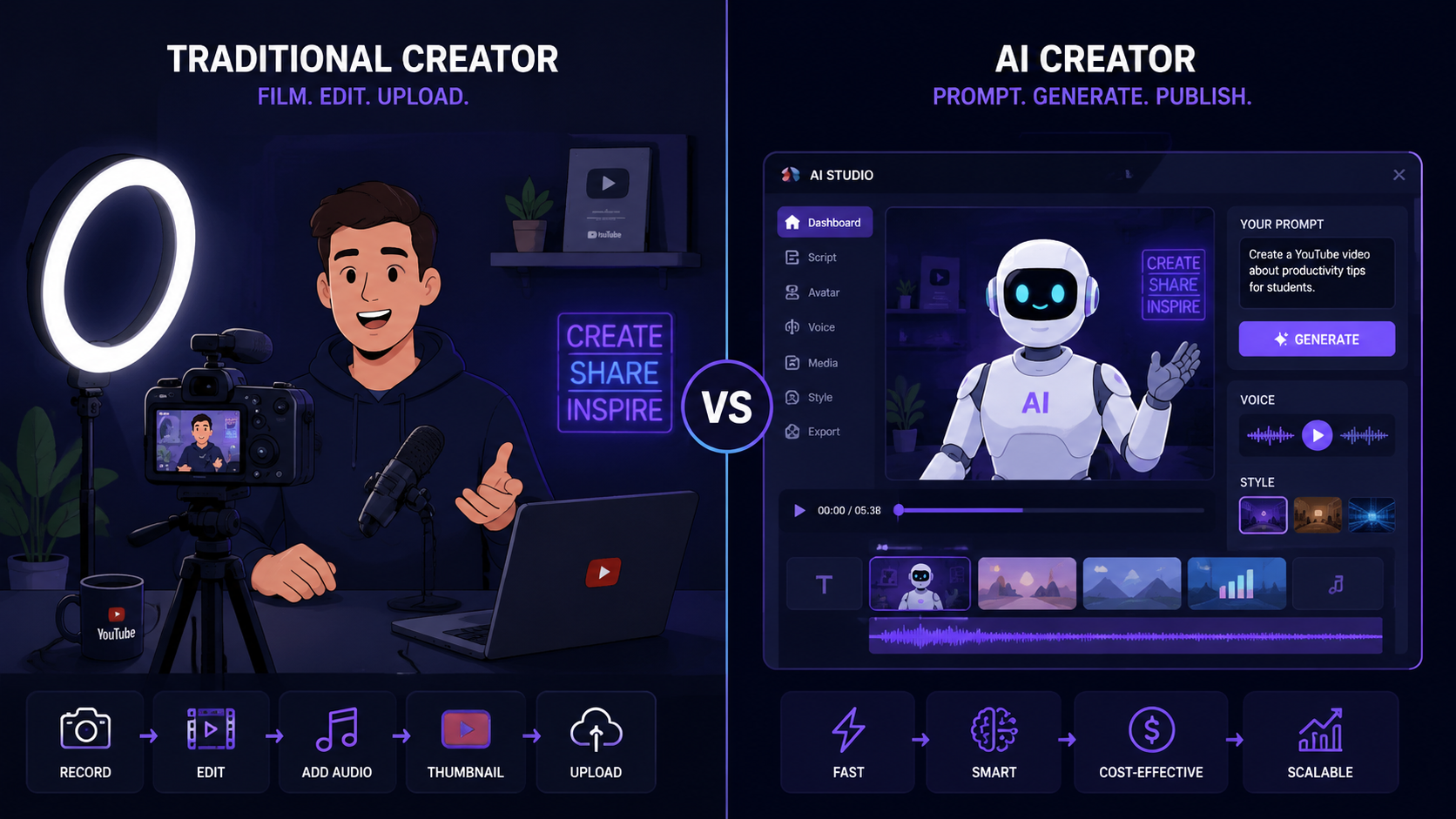
YouTube automation is the system behind those channels. You use AI tools, stock footage, and a repeatable workflow to publish videos without filming yourself. The result is a channel that earns ad revenue whether you're at your desk or asleep. It's not magic and it's not instant, but the economics are real and the tools are mostly free.
This guide gives you the exact free tool stack, a step-by-step production workflow that takes under 90 minutes per video, an honest monetization timeline, and the policy rules you need to follow so your channel doesn't get demonetized before it earns its first dollar. Let's get into it.
The Bottom Line
- YouTube generated $18.72 billion in ad revenue in H1 2025 alone, and faceless automation channels capture a real slice of that (Backlinko/Google, Oct 2025).
- Only 3 million of YouTube's 115 million channels are in the Partner Program, meaning most of your competition never monetizes (DemandSage, 2025).
- The average time to first earnings is 6.5 months. Average time to self-supporting income is 17 months. Plan accordingly.
- Your full production workflow, from idea to published video, can run on free tools and take under 90 minutes per video.
- Finance and business niches earn $15-40 RPM vs. $2-5 for gaming. Niche choice directly affects how fast you monetize.
What Is YouTube Automation (and Does It Actually Work)?
Only 3 million of YouTube's 115 million channels have qualified for the Partner Program (DemandSage, 2025). That gap exists partly because most creators burn out trying to do everything manually. YouTube automation closes that gap by replacing the manual steps with AI tools and systems. Think of it like a vending machine business: once you stock the machine, it keeps earning without you standing next to it every hour.
YouTube automation means outsourcing or AI-replacing every step of video production. Research, scripting, voiceover, editing, thumbnails, SEO, all of it gets systematized. You don't appear on camera. You're not the face of the channel. You're the operator of a content system that produces videos on a schedule.
Here's what it doesn't mean: effortless income starting on day one. The average time to a creator's first dollar earned is 6.5 months, and the average time to self-supporting income is 17 months (DemandSage, 2025). That's not a reason to quit before you start. It's a reason to treat this like the real business it is, not a lottery ticket. If you go in with realistic expectations, the system works. If you expect $5,000 in month two, you'll quit in month three.
YouTube automation is a content production system where AI tools and outsourcing replace manual filming and editing. With only 3 million of 115 million YouTube channels in the Partner Program (DemandSage, 2025), and an average 6.5-month runway to first earnings, automation channels succeed when creators treat them as businesses rather than passive income shortcuts.
Pick the Right Niche (CPM Changes Everything)
YouTube automation channels earn anywhere from $1.61 to $29.30 per 1,000 views depending on niche (Influencer Marketing Hub, May 2026). That's not a rounding error, that's a 18x difference in revenue from the same number of views. Choosing your niche is like choosing which neighborhood to open a store in: same effort, same hours, wildly different revenue.
Finance and business channels sit at the top of the RPM table because advertisers pay a premium to reach people who have money or want to make it. Entertainment channels sit at the bottom because their audience skews younger and advertisers pay less for that attention. For AI automation specifically, the research-heavy and explainer-style niches are the best fit because the scripts can be built almost entirely from structured information.
| Niche | RPM Range | Difficulty | Good For AI Automation? |
|---|---|---|---|
| Finance / Investing | $15-40 | High | Yes (research-heavy, perfect for AI) |
| Business / B2B | $12-25 | Medium | Yes (explainer format) |
| Health / Wellness | $8-15 | Medium | Yes (evergreen scripts) |
| Education | $5-12 | Low-Med | Yes (tutorial format) |
| Entertainment | $3-7 | Low | Yes (but saturated) |
| Gaming | $2-5 | Low | Partial (commentary needed) |
Don't pick a niche just because you like it. Pick a niche where the RPM is decent and AI can do most of the research work. Finance, business, and health check both boxes. Use the YouTube Keyword Generator to find low-competition topics within your chosen niche before you build your first video. Chasing a saturated keyword in month one is one of the most common ways people waste their early momentum.
YouTube automation channel RPM ranges from $1.61 in low-value niches to $29.30 in finance and business categories (Influencer Marketing Hub, May 2026). For creators starting a faceless AI channel, high-CPM niches like finance and B2B offer the same production effort as entertainment but deliver up to 18 times more revenue per 1,000 views.
The Free AI Tool Stack for YouTube Automation
YouTube Partner Program members earn between $1.61 and $29.30 per 1,000 views, and most high-earning automation channels launch on a free tool stack (Influencer Marketing Hub, 2026). You don't need a Michelin-star kitchen to open a restaurant. You need a working kitchen. Here's yours.
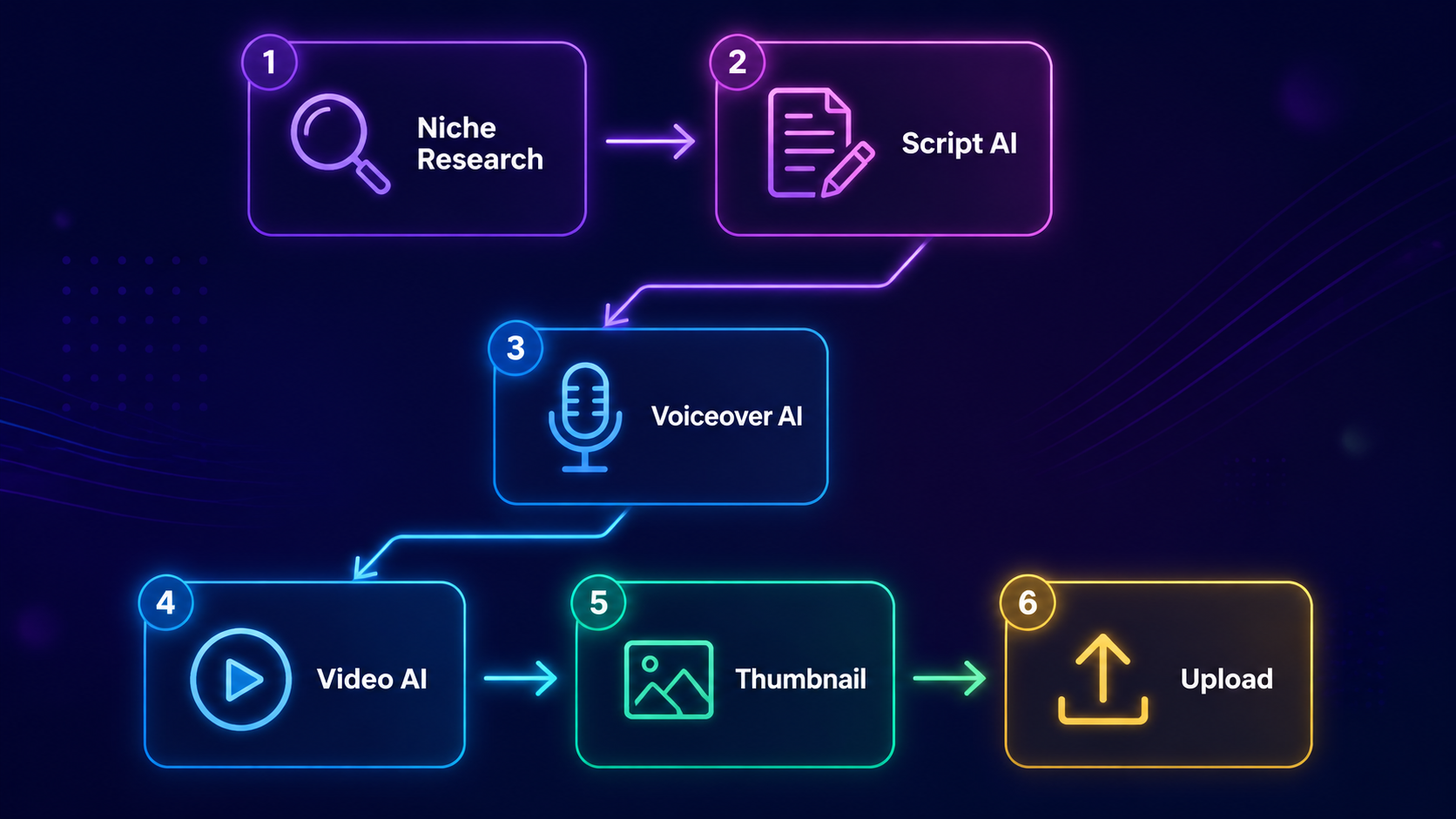
This workflow runs left to right: idea, script, voice, visuals, thumbnail, title, description, tags. Each step has a dedicated free tool. The total production time per video, once you've done it twice, is under 90 minutes. Zero dollars required.
- Video Idea (10 min). Use the YouTube Video Idea Generator to find trending topics in your niche with real search demand. Don't guess. Let the data tell you what people are already looking for.
- Script (15 min). Use the YouTube Script Generator for a full structured script (hook, body, CTA) in one click. Edit for voice and add your own angle. The AI gives you 80% of the structure; you supply the original perspective.
- Voiceover (15 min). The free tier of ElevenLabs gives you 10,000 characters per month. That's roughly one full video script. Alternatively, record your own voice with your phone mic in a quiet room. It works better than people think.
- Visuals (20 min). Pull stock footage from Pexels or Pixabay (both free, no attribution required). Edit in CapCut's free version for auto-captions and simple cuts. You don't need Final Cut Pro to publish a clean video.
- Thumbnail (10 min). Canva's free plan handles everything you need. Use the Midjourney Prompt Generator to create an AI-generated visual concept first, then bring it into Canva and add your title text.
- Title (3 min). Use the YouTube Title Generator for click-worthy titles tested against your keyword. Strong titles do more for CTR than almost anything else you can optimize.
- Description (5 min). Use the YouTube Description Generator for keyword-rich descriptions with CTAs already built in. Don't leave this blank. YouTube's algorithm reads descriptions.
- Tags and Hashtags (3 min). Use the YouTube Tag Generator and the YouTube Hashtag Generator to round out your metadata. Tags matter less than they used to, but skipping them entirely is leaving easy SEO on the table.
Total: Under 90 minutes per video. Zero dollars.
A complete YouTube automation workflow, covering video ideation, scripting, voiceover, editing, thumbnail creation, title optimization, and metadata, can run entirely on free tools including ElevenLabs' free tier (10,000 characters/month), Pexels, CapCut, and Canva. Total production time per video is under 90 minutes at zero cost.
The Honest Monetization Timeline
The average time to a creator's first dollar earned is 6.5 months, and the average time to self-supporting income is 17 months (DemandSage, 2025). That sounds slow until you realize most businesses take 2-3 years to turn a profit. Automation channels are more like planting a garden: nothing looks like it's working for weeks, and then things suddenly start growing.
The YouTube Partner Program requires 1,000 subscribers and 4,000 watch hours in the past 12 months before you can monetize. Those numbers aren't unreachable, but they're not instant either. Hitting them faster comes down to two things: niche selection and publishing consistency. Finance and tech niches hit the watch hour threshold faster because viewers tend to watch longer, more in-depth content in those categories.
| Timeline | Milestone | Focus |
|---|---|---|
| Month 1-2 | 0-100 subscribers | Test content formats, find what gets watched |
| Month 3-4 | 100-500 subscribers | Double down on best-performing format |
| Month 5-6 | First $ earned (avg) | Hit YPP: 1K subs + 4K watch hours |
| Month 6-12 | YPP eligibility | Optimize SEO, batch content production |
| Month 12-17 | Self-supporting income (avg) | Add affiliate + digital products |
Your niche choice directly affects monetization speed, not just earnings per view. A finance channel where viewers watch 8-12 minute explainer videos accumulates watch hours far faster than an entertainment channel where people bail after 90 seconds. Build your channel in a high-RPM, high-retention niche and you're solving two problems at once.
Use the YouTube Money Calculator to estimate your potential earnings at different subscriber and view counts in your chosen niche. Running the numbers before you start helps you set realistic revenue targets for months 6, 12, and 17.
YouTube creators take an average of 6.5 months to earn their first dollar and 17 months to reach self-supporting income (DemandSage, 2025). Channels in high-retention niches like finance and technology typically hit the 4,000 watch-hour YPP threshold faster than entertainment channels because viewers consistently watch longer-form, in-depth content.
The YouTube Policy Risk You Can't Ignore
YouTube removed over 5 million channels in 2023 alone for policy violations (Google Transparency Report, 2024). Getting demonetized before you earn your first dollar is like building a house without pulling the permit: the structure looks fine until it doesn't. Policy risk is the one thing most YouTube automation guides skip, and it's the one thing that can end your channel overnight.
Here's exactly what gets automation channels flagged or demonetized:
- Repetitious content: Reusing the same template structure with only minor keyword swaps gets flagged. YouTube's systems detect it. Every video needs a structurally distinct approach, not just a new topic dropped into an identical format.
- Reused clips without commentary: Stock footage compilations with no original narration are penalized under YouTube's "reused content" policy. The footage must support an original editorial voice, not replace one.
- AI voice reading scraped text: Channels where an AI voice simply reads text pulled from Wikipedia or news articles are being demonetized at scale. The script must contain your original analysis, framing, or insight.
What's actually safe: original scripts, AI-assisted voiceover, licensed stock footage, and real editorial judgment. That combination is explicitly within YouTube's guidelines. The issue isn't using AI. The issue is using AI to produce content that has no original value for viewers.
Three rules to stay in the clear. First, every video needs a unique angle, not just a new keyword. Second, your script must add original insight, not paraphrase a Wikipedia article. Third, don't use scraped or reused footage without adding your own commentary on top of it. Follow those three rules and you're building something sustainable.
YouTube removed over 5 million channels in 2023 for policy violations (Google Transparency Report, 2024). Automation channels face specific demonetization risks from repetitious content, reused footage without commentary, and AI voiceover reading scraped text. Channels using original scripts, licensed stock footage, and genuine editorial value remain fully within YouTube's monetization policies.
Frequently Asked Questions
Is YouTube automation worth it in 2026?
Yes, but only if you're willing to treat it as a real content business. YouTube paid out $18.72 billion in ad revenue in the first half of 2025 (Backlinko/Google, Oct 2025), and faceless channels capture a meaningful share of that. The ones that fail treat it like a passive side project. The ones that succeed treat it like a 90-minute-a-day business.
How much money can a YouTube automation channel make?
It depends almost entirely on niche. Finance and investing channels earn $15-40 RPM, meaning $15-40 per 1,000 views. Gaming and entertainment channels earn $2-7 RPM (Influencer Marketing Hub, May 2026). A finance channel hitting 100,000 monthly views earns roughly $1,500-4,000 per month from ads alone, before affiliate income or digital products.
Do I need a lot of money to start a YouTube automation channel?
No. The full production workflow in this guide runs on free tools: ElevenLabs free tier (10,000 characters/month), Pexels and Pixabay for stock footage, CapCut for editing, and Canva for thumbnails. The only real cost is time. Most successful automation channels started with zero budget and reinvested early ad earnings into paid tools once the channel was generating revenue.
How long does it take to monetize a YouTube automation channel?
The average time to first earnings is 6.5 months, and the average time to reach self-supporting income is 17 months (DemandSage, 2025). Channels in high-retention niches like finance and business typically hit the 1,000 subscriber and 4,000 watch hour YPP thresholds faster because viewers watch longer videos in those categories.
Will YouTube ban my channel for using AI?
No, not for using AI itself. YouTube's policies target content that lacks original value, not content made with AI tools. Channels using AI voiceover on original scripts, paired with licensed stock footage and genuine editorial analysis, are fully compliant. What gets channels removed is repetitious content, scraped text narration, and reused footage without added commentary. Originality is the actual rule.
Your First Video Is 90 Minutes Away
You now have everything you need. The niche data, the free tool stack, the step-by-step workflow, the monetization timeline, and the three policy rules that keep your channel safe. Nothing in this guide requires a budget, a camera, or a face. It requires 90 minutes and a decision to actually start.
Before you publish, run your video through our YouTube SEO checklist — title, description, tags, and thumbnail optimized in 15 steps before the video goes live. The biggest thing that separates channels that grow from channels that sit at zero isn't talent or equipment. It's the first video. Not a perfect video. Just a published one. The algorithm can't recommend something that doesn't exist.
Pick your niche, find a topic with real search demand, and use the YouTube Video Idea Generator to lock in your first video right now. The tool stack is free. The system is mapped. The only thing left is you showing up.