The Bottom Line
- 55% of YouTube viewers leave within the first 60 seconds when the opener fails to hook them (Retention Rabbit, 2025)
- Educational how-to videos average 42.1% retention, nearly double the 21.5% average for vlogs, and scripting is the main reason
- Videos with a clear value proposition in the first 15 seconds see 18% higher retention at the 1-minute mark
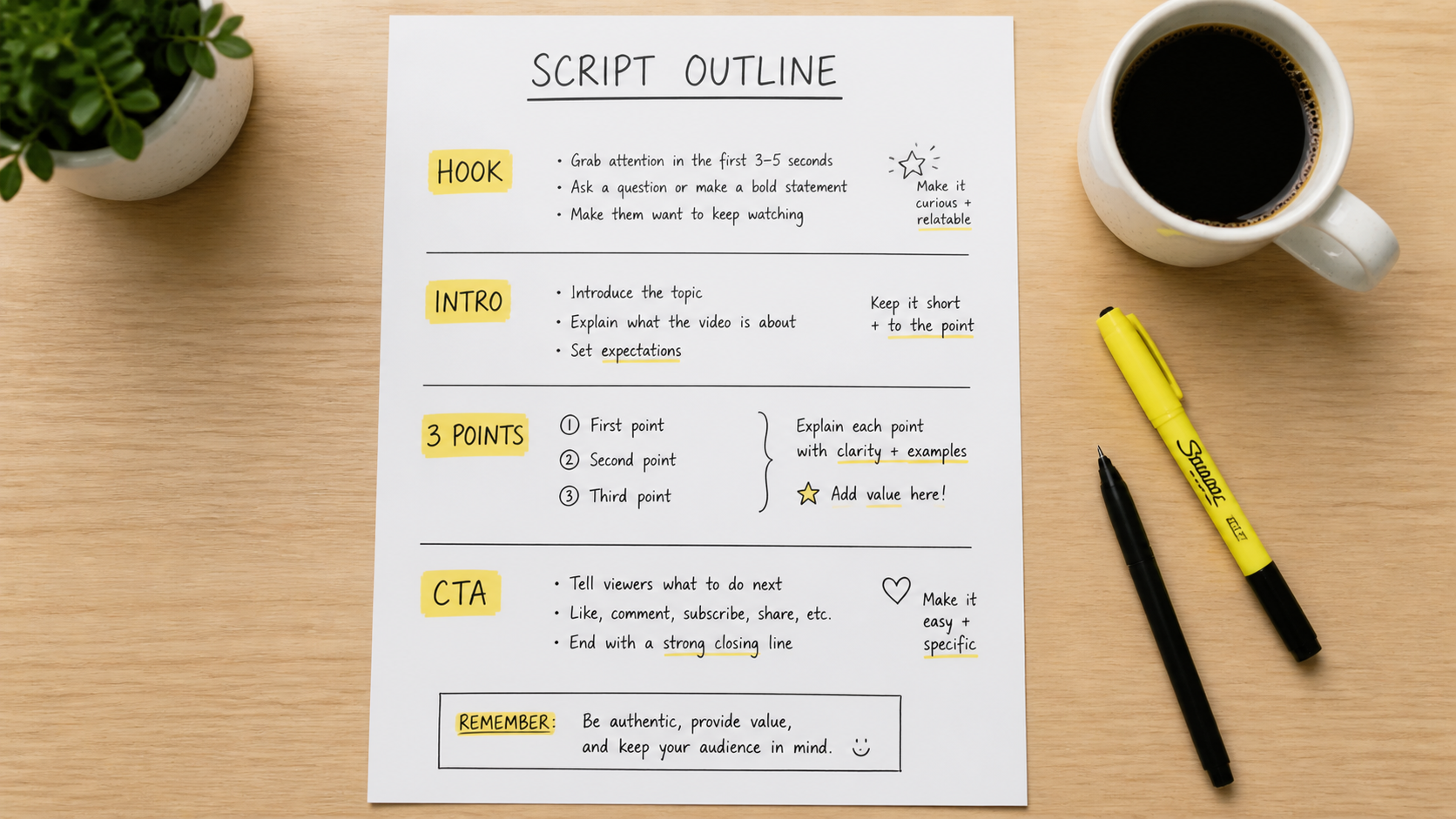
- A solid script follows four sections: Hook, Intro, Body (3 key points), and CTA. That's it.
- For every minute of video, write roughly 150 words. A 10-minute video needs a 1,500-word script
Most beginner YouTubers film their first video without a script. They turn on the camera, start talking, and figure it out as they go. Then they watch the footage back and delete the whole thing.
Sound familiar? Yeah. We've all been there.
Here's the truth: the hardest part of making YouTube videos isn't the editing or the camera setup. It's knowing what to say and in what order. That's exactly what a script solves. This guide walks you through the whole process, step by step, with a free template you can copy and use today.

Why Scripting Your YouTube Videos Actually Matters
Scripted videos hold viewers longer. That's not an opinion. It's in the data. Educational how-to videos average 42.1% audience retention, compared to just 21.5% for unscripted vlogs. That's almost double. The difference? Structure. Scripted videos stay on point, eliminate filler, and deliver value faster (Retention Rabbit, 2025).
Better retention also means better distribution. The YouTube algorithm rewards watch time. Channels that improve their retention by 10 percentage points see 25%+ more impressions from the algorithm. More impressions, more views, more growth. It all starts with a better script.
According to Retention Rabbit's 2025 YouTube Audience Retention Benchmark Report, the overall average YouTube retention rate is 23.7%, and only 1 in 6 videos ever surpasses the 50% mark. Educational how-to videos lead all content types at 42.1% average retention, nearly double the 21.5% for vlogs. Channels in the top retention quartile see 3.5x higher subscriber growth than average (Retention Rabbit, 2025).
The Four-Part YouTube Script Structure Every Beginner Needs
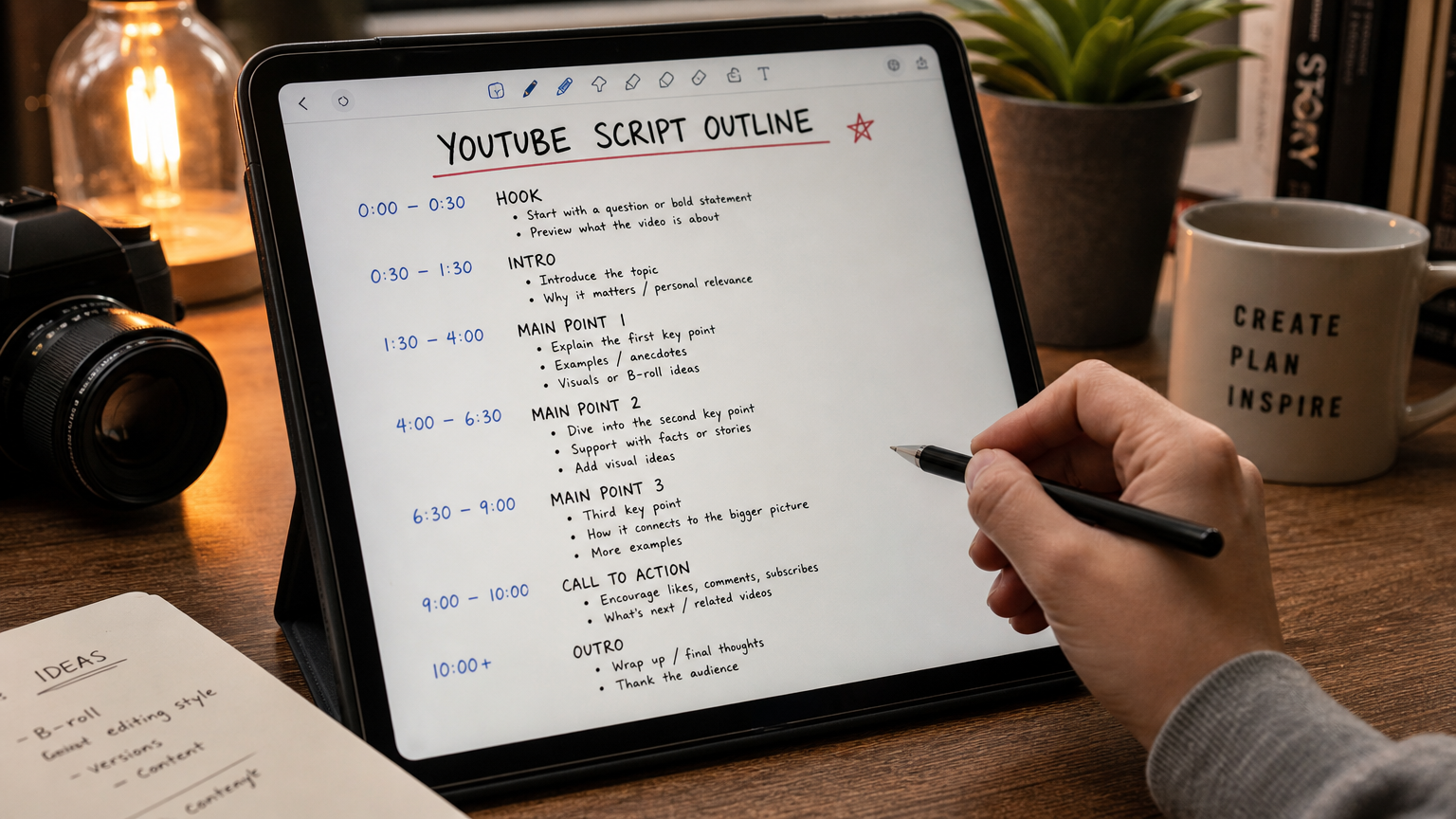
You don't need a complicated script. Every high-performing YouTube video follows the same four-part structure: Hook, Intro, Body, and Call to Action. Get those four parts right and you've got a script that keeps people watching. Here's what each section actually does and how long it should be (Humble&Brag, 2026):
- Hook (0-15 seconds): Validate the click and open a curiosity loop. Viewers decide in 8 seconds whether to stay.
- Intro (15-60 seconds): Name the problem, promise the payoff, establish credibility briefly.
- Body (80% of video): Three key points maximum. Each one answers a question the viewer already has.
- CTA (last 30 seconds): One action only. Ask for a subscribe, a comment, or a click to another video.
Videos with a clear value proposition delivered in the first 15 seconds see 18% higher retention at the 1-minute mark, according to Retention Rabbit's 2025 benchmark data. Strong first-minute retention above 65% correlates with 58% higher average view duration across the entire video. The 8-second consideration window is when most viewers decide whether to stay or leave (Retention Rabbit, 2025).
Step 1: Write Your Hook Last (Seriously)
This sounds backwards. But it works. Write the body of your video first: all your key points, examples, and explanations. Once the body is done, the hook almost writes itself because you know exactly what the video delivers. Trying to write the hook first means you're promising something you haven't figured out how to deliver yet (Humble&Brag, 2026).
What makes a hook work? It needs to do three things in 15 seconds or less: validate the click (confirm the viewer came to the right place), raise the stakes (make them care), and open a curiosity loop (give them a reason to keep watching). A question works well. So does a bold claim. So does starting mid-action.
What doesn't work? Saying "Hey guys, welcome back to my channel!" and then taking 45 seconds to get to the point. Nobody cares. 55% of your viewers will be gone before you finish that intro (Retention Rabbit, 2025).
The average YouTube viewer makes their stay-or-leave decision within 8 seconds, and 55% of viewers are lost within the first 60 seconds when the opening fails to create an effective curiosity loop. Casual viewers show a 60% drop-off in the first 30 seconds with slow intros, compared to only 35% for dedicated learners. A hook needs to validate the click, raise the stakes, and open one curiosity loop within 15 seconds (Retention Rabbit, 2025).
Step 2: Write an Intro That Earns the Next 5 Minutes
Your intro runs from 15 to 60 seconds. That's your entire budget before the algorithm starts tracking the drop-off. Use it carefully. The intro should do four things, in this order: name the problem precisely (not vaguely), confirm who the video is for, promise the specific payoff, and briefly establish why they should trust you (StudioBinder, 2026).
Keep the credibility part short. One sentence. "I've grown three channels past 10K subscribers using this exact structure" beats "Hi, I'm a content strategist with 7 years of experience." Show the result, not the resume.
Step 3: Build the Body with Three Key Points
Three points. Not five, not seven. Three. This isn't a random number. It's based on how people actually retain information when watching video. More than three main ideas and viewers start tuning out. Each point should answer one question your viewer already has, deliver one actionable takeaway, and set up the next point naturally (vidIQ, 2026).
How long should each section be? Use the word count formula: roughly 150 words per minute of video. A 10-minute video needs about 1,500 words total. Split that evenly across three points and you're looking at 300-400 words per section. That's two to three short paragraphs. Totally manageable. If you'd rather skip the blank page entirely, our YouTube Script Generator builds out all three body sections from just your topic.
YouTube audience retention peaks for videos in the 5-10 minute range at 31.5%, compared to 23.7% average across all video lengths, according to Retention Rabbit's 2025 benchmark report. The standard word count formula for YouTube scripts is approximately 150 words per minute, meaning a 10-minute video requires a 1,500-word script. Limiting body sections to three key points maximizes information retention for viewers and reduces mid-video drop-off (Retention Rabbit, 2025).
Step 4: End with One Clear CTA
The call to action is the last 30 seconds. One action only. Not "like, comment, subscribe, and follow me on Instagram." Pick one. If your goal is channel growth, ask for a subscribe. If your goal is engagement, ask a specific question in the comments. If you want watch time, link to your next video. Asking for too many things gets you none of them (vidIQ, 2026).
The CTA works best when it's connected to the video's topic. If your video teaches script writing, your CTA could be: "Download the free YouTube script template linked in the description and use it for your next video." Relevant, specific, and actionable.
Free YouTube Script Template (Copy and Use This)
Here's the exact template. Copy it, paste it into Notion or Google Docs, and fill it in for your next video:
--- YOUTUBE SCRIPT TEMPLATE ---

[HOOK: 0 to 15 seconds]
Write this LAST. Open with: a bold claim, a question, or
mid-action. Validate the click. Raise the stakes. Open
one curiosity loop.

[INTRO: 15 to 60 seconds]
- Name the problem precisely: "If you're [situation], then..."
- Confirm who it's for: "This is for [specific audience]..."
- Promise the payoff: "By the end of this video, you'll know..."
- 1-sentence credibility: Lead with results, not your title.

[BODY - Point 1]
Question this point answers: [write it here]
Main explanation: [150-300 words]
Example or demo: [specific, not vague]
Transition to Point 2: [bridge sentence]

[BODY - Point 2]
Question this point answers: [write it here]
Main explanation: [150-300 words]
Example or demo: [specific, not vague]
Transition to Point 3: [bridge sentence]

[BODY - Point 3]
Question this point answers: [write it here]
Main explanation: [150-300 words]
Example or demo: [specific, not vague]
Quick recap sentence: [tie it together]

[CTA: Last 30 seconds]
One action only: [subscribe / comment question / next video]
Make it topic-relevant: "Now that you know X, go do Y..."

Word count check: Video length x 150 = target word count
  5 min video = ~750 words
  8 min video = ~1,200 words
 10 min video = ~1,500 words
Want to skip straight to a finished script? The YouTube Script Generator on CreatorsToolHub fills in this exact structure for you in about 30 seconds.
Frequently Asked Questions
Should I memorize my YouTube script or read it?
Neither. The best approach is to internalize the structure and key points, then speak naturally. Memorizing leads to robotic delivery. Reading off a script looks stiff on camera. Use your script as a safety net, not a word-for-word guide. Know your three main points cold, and use the script to keep yourself on track when you lose the thread.
How long should a YouTube script be?
Use the 150-words-per-minute formula. A 5-minute video needs roughly 750 words. A 10-minute video needs about 1,500 words. For beginners, a 5-7 minute video (750-1,050 words) hits the sweet spot: short enough to film without losing your place, long enough to deliver real value. Research shows 5-10 minute videos have the highest average retention at 31.5%.
Do scripted YouTube videos perform better than unscripted ones?
Yes, significantly. Educational how-to videos (which are almost always scripted) average 42.1% audience retention, compared to 21.5% for vlogs (which are typically unscripted). That's nearly double. Scripting eliminates filler, tightens structure, and keeps viewers watching longer. The algorithm rewards higher retention with more impressions, which creates a compounding growth advantage over time.
Can I use AI to write my YouTube script?
You can use AI as a starting point, but don't publish AI scripts as-is. AI-generated content shows 70% lower retention than human-fronted content, largely because AI narration lacks personality, specific examples, and genuine experience. The better approach: use ChatGPT to generate an outline and bullet points, then write the actual script yourself using your own voice and examples. Or try our free YouTube Script Generator to get a full structured draft in seconds.
What's the most important part of a YouTube script?
The hook. Hands down. 55% of viewers leave within the first 60 seconds, and the average viewer decides whether to stay within 8 seconds. The rest of the video doesn't matter if your hook doesn't earn their attention first. Spend at least 20% of your scripting time on the first 15 seconds. Write 5-10 different versions and pick the strongest one.