Key Takeaways
- TikTok reached 1.99 billion monthly active users in Q4 2025, making it the world's 5th most-used social platform — and only 26% of marketers are actively using it (Sprout Social, 2026).
- TikTok's algorithm judges every video on completion rate, not follower count. A brand-new account can outperform a 100,000-follower account on the same day.
- Accounts with 1,000 to 5,000 followers earn a 4.40% engagement rate — the highest of any tier on the platform (Socialinsider, April 2026).
- The 1,000-follower milestone unlocks TikTok LIVE and Creator Rewards eligibility. At 10,000 followers, the full Creator Rewards Program opens with per-view payments.
- 63% of top-performing TikTok videos hook viewers within the first 3 seconds. Hook quality is the single highest-leverage variable in TikTok growth.
TikTok is the only major social platform where a creator with zero followers has the same initial distribution opportunity as a creator with a million. The For You Page algorithm tests every video with a seed audience of 100 to 300 people and expands based on completion rate, not account authority. This makes it the most accessible platform for new creators — and the one where inconsistent posting has the fastest consequences.
This guide maps the TikTok growth system from scratch: how the algorithm works, how to pick a niche before you post your first video, how to go viral without followers, what changes after 1,000 followers, and how hook quality determines whether the algorithm shows your content to anyone beyond the seed pool.
Every section links to a dedicated deep-dive guide. Use this page as a map, then go deep on whatever phase you are currently in.
How TikTok's Algorithm Works in 2026
TikTok's For You Page algorithm operates in audience pools. Every video is first shown to a seed group of 100 to 300 viewers. If completion rate clears approximately 70% in that pool, TikTok expands distribution to 1,000 to 5,000 viewers. Clear that pool and it expands to 10,000 to 50,000. Each expansion gate is cleared by completion rate, share rate, and comment velocity — in that order of weight.
Follower count does not affect initial seed pool size or composition for accounts under 10,000 followers. This is TikTok's structural advantage for new creators: the algorithm is agnostic to your account age, previous video performance, or subscriber history on day one. What it cares about is whether the 300 people who just saw your video watched it all the way through.
After 1,000 followers, the algorithm adds a second distribution layer: your follower feed. A percentage of each new video now goes directly to people who already follow you. This is why niche consistency matters more after 1K than before it — your follower base becomes the seed data for lookalike targeting. Scattered content gives the algorithm no signal to replicate.
Our guide on how to get on the TikTok For You Page covers the full expansion mechanics, the signals TikTok weights most heavily in 2026, and the content formatting decisions that affect completion rate from the first frame.
Citation capsule: TikTok's algorithm tests every video in a seed pool of 100 to 300 viewers and expands based on completion rate. The platform's average engagement rate reached 3.73% across all account sizes in 2026, a 4.1% decline from 2025 — but accounts in the 1,000-to-5,000 follower tier maintained 4.40%, the highest of any bracket on the platform (Socialinsider, April 2026, 2M videos analysed).
Starting on TikTok — Niche, First Videos, and the Sandbox Stage
Every new TikTok account goes through a sandbox stage for the first 10 to 20 videos. During this period, TikTok is building a data model of your content — what topics you cover, what audience responds, and how consistently the two align. Videos posted during the sandbox are more likely to land in front of irrelevant audiences. This is not a punishment. It is a calibration phase, and most beginners misread it as failure.
The two decisions that determine how quickly you exit the sandbox are niche selection and posting consistency. Niche selection tells TikTok what your channel is about so the algorithm can find the right audience faster. Posting consistency gives TikTok more data points to refine audience matching. Most accounts that fail in the first 30 days post sporadically across unrelated topics — which gives the algorithm nothing to work with.
Our guide on how to find your TikTok niche as a complete beginner covers the niche selection process: how to identify sub-niches with less competition, how to validate that an audience exists before you commit, and the CPM data that helps you choose a niche based on future monetization potential rather than just personal interest.
For the full zero-to-viral strategy — including the 5-step formula, the 70% completion rule, and how to troubleshoot the "stuck at 200 views" problem — our TikTok viral guide for beginners with 0 followers is the complete playbook.
Growing From 1,000 to 10,000 Followers — The Mid-Account Strategy
Reaching 1,000 followers proves your content works. Growing from 1,000 to 10,000 requires a different strategy than getting to 1K. The algorithm changes, the content format that worked shifts, and the biggest growth lever moves from hook quality to content pillar consistency.
At 1,000 followers, three things unlock: TikTok LIVE, the ability to receive viewer gifts during live streams, and the start of Creator Rewards eligibility tracking. At 10,000 followers, the full Creator Rewards Program opens — the monetization mechanism that pays per 1,000 qualified views. This makes 10K the real financial milestone on TikTok, not 1K.
The most common reason accounts stall between 1K and 3K is a content mismatch: the broad, beginner-oriented content that attracted the first followers is no longer what that audience wants. Existing followers want depth. When they don't get it, completion rates drop, distribution shrinks, and growth stalls. The fix is a content audit focused on total play time rather than views.
Our TikTok 1K-to-10K growth guide covers the 60-day posting plan, the algorithm shift after 1,000 followers, content formats that scale in this tier (the "I tested it" video, niche tutorials, the "most people don't know this" reveal), and Duet and Stitch strategies for borrowing larger creators' discovery surfaces. Free tools to accelerate this phase: TikTok Viral Idea Generator for topic research and TikTok Hook Generator for hook testing.
TikTok Hooks — The Most Important Creative Skill on the Platform
A TikTok hook is the first 2 to 3 seconds of your video. It is the only thing that determines whether a viewer swipes away or watches. 63% of the top-performing TikTok videos hook viewers within the first 3 seconds, according to a Kantar study of 3,500 videos commissioned by TikTok for Business. The hook does not just capture attention — it is the primary signal that drives the algorithm's expansion decision in the first audience pool.
There are 9 distinct hook types that generate high completion rates across different niches: the Pattern Interrupt, the Bold Claim, the Before-After, the Specific Lie, the Question hook, the Relatable Pain, the Numbers hook, the Controversy hook, and the Story hook. Each works differently for different audiences and content formats. Using the same hook type every video creates predictability that reduces engagement over time — rotating through 3 to 4 types keeps your format fresh for returning viewers while the novelty captures new ones.
Our TikTok hook examples guide covers all 9 hook types with real examples, the niche-specific formats that perform best in each category, and how to write a hook in under 2 minutes. The TikTok Hook Generator builds hooks across all 9 types for any niche in seconds — use it to generate 10 variations and A/B test the best 2 each week.
Free TikTok Tools at CreatorsToolHub
Every TikTok tool below is free, requires no account, and covers a specific bottleneck in the TikTok content creation process — from idea generation to earnings estimation.
- TikTok Viral Idea Generator — Content ideas with strong search and FYP potential for your niche
- TikTok Hook Generator — Scroll-stopping first lines across all 9 hook types
- TikTok Script Generator — Full TikTok scripts with hook, body, and CTA
- TikTok Caption Generator — Captions with niche keywords and engagement-driving questions
- TikTok Hashtag Generator — Niche hashtags that help TikTok categorize your content
- TikTok Bio Generator — Bios that convert profile visitors into followers
- TikTok Username Generator — Memorable, niche-aligned username ideas
- TikTok Money Calculator — Estimate TikTok Creator Rewards earnings from your view count
Frequently Asked Questions
How long does it take to grow to 1,000 TikTok followers?
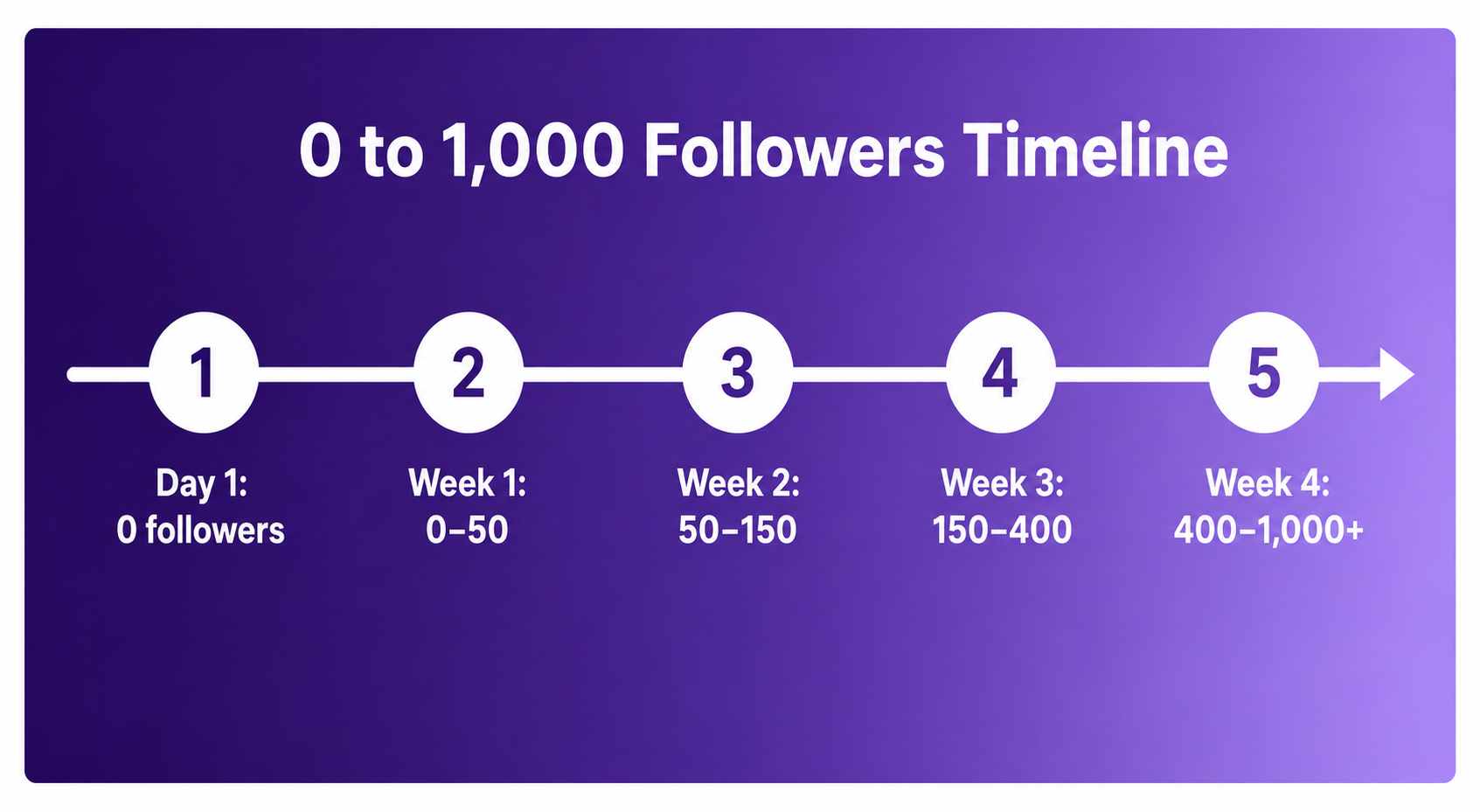
Most accounts with a focused niche and consistent 3-to-5-videos-per-week schedule reach 1,000 followers in 2 to 6 weeks. Accounts posting daily in a well-defined niche with high-completion hooks can hit 1,000 in under 2 weeks. Accounts posting sporadically across unrelated topics can take months. The primary variable is not post volume but niche clarity — TikTok's algorithm finds your audience faster when your content consistently signals the same topic. For the complete strategy, see our TikTok guide for zero-follower accounts.
What does TikTok pay per 1,000 views?
TikTok's Creator Rewards Program pays $0.40 to $1.00 per 1,000 qualified views, depending on content category, viewer location, and video quality score. This is the direct in-app payment mechanism and requires 10,000 followers and 100,000 views in the past 30 days to qualify. Most creators supplement Creator Rewards with brand deals, which start becoming accessible at 10,000 followers with a 2%+ engagement rate. Use the TikTok Money Calculator to model realistic earnings from your current view count.
How often should you post on TikTok to grow?
Posting 3 to 5 times per week drives up to 17% more views per individual video compared to posting once weekly, according to Buffer's 2025 TikTok analysis. Beyond 5 posts per week, returns diminish for most accounts. The most effective pattern for the 0-to-1K phase is 4 videos per week across 3 content pillars, with consistent hook variation. Quality drops at daily posting frequency for most solo creators — 3 to 4 strong videos outperform 7 rushed ones.
Why is my TikTok reach so low?
Low reach after the first 20 videos usually signals one of three problems: hooks are not holding viewers past the 3-second mark (check completion rate in Analytics), content pillars are too broad for the algorithm to categorize (refine your niche), or posting frequency dropped below 2 times per week (the algorithm deprioritizes accounts that post sporadically). Open TikTok Analytics, sort your last 30 videos by total play time (not views), and identify the 3 videos with the highest play time. Those are your content pillars. Build from them.
Can you make money on TikTok without showing your face?
Yes. Faceless TikTok content works well in educational, tutorial, and "satisfying process" niches. Text-on-screen videos, screen recordings, product reviews with hands-only shots, and AI voiceover content all perform in faceless formats. The algorithm does not differentiate between face and faceless content in its ranking signals — completion rate and shares are platform-agnostic. For niche ideas suited to faceless content, the TikTok Viral Idea Generator includes format suggestions alongside topic ideas.