You've got zero followers, a phone, and a dream. TikTok's algorithm doesn't care about any of that. Here's the wild part: it actually doesn't care that you have zero followers either. Unlike every other platform (looking at you, Instagram), TikTok gives every single new account a fair shot at getting seen. Think of it like a courtroom where your content gets to plead its case to a jury of real viewers, and follower count isn't even admissible evidence.
The catch? TikTok is testing you. Every video you post goes through a scoring system before it reaches anyone significant. Most beginners don't know this exists. They post three videos, get 47 views, and quit. Don't be that person. This guide covers exactly how the algorithm works, what to do before you post a single video, and the honest timeline for going viral when you're starting from scratch.
The Bottom Line
- TikTok's algorithm tests every new video with 200-500 initial viewers before wider distribution
- Small accounts under 5K followers average 4.86% engagement, nearly double the rate of large accounts (Social Insider, 2026)
- The viral threshold is a 70%+ video completion rate
- Profile setup, niche clarity, and hook quality matter more than follower count
- Most accounts that go viral took 3-6 months of consistent posting to get there
What Does the TikTok Algorithm Actually Look At in 2026?
TikTok's algorithm weights video completion rate above every other signal, according to a Social Insider analysis of 70 million+ posts in 2026. The platform's average engagement rate hit 3.73%, a 49% year-over-year increase. That means good content is getting rewarded faster than ever. The algorithm ranks signals in this order: completion rate, then shares, then comments, then likes.
Why does completion rate win? Because a watched video means a satisfied viewer, and TikTok's entire business model depends on keeping people on the app. Users spend an average of 95 minutes per day on TikTok (DataReportal, 2026). Every video that gets watched fully is a tiny win for TikTok's retention numbers, so the algorithm rewards those videos with more distribution.
Here's what that means practically. A 15-second video watched all the way through beats a 3-minute video watched halfway. It's not about length. It's about the ratio. Keep videos tight, especially early on. The completion rate formula is simple: shorter videos are physically easier to complete.
TikTok's algorithm prioritizes completion rate over all other engagement signals, according to Social Insider's 2026 study of 70 million+ posts. The platform's average engagement rate reached 3.73%, a 49% year-over-year increase, with small accounts under 5K followers outperforming larger ones at 4.86% vs 2.06%.
The Sandbox Stage: Why Your First 10 Videos Are a Test
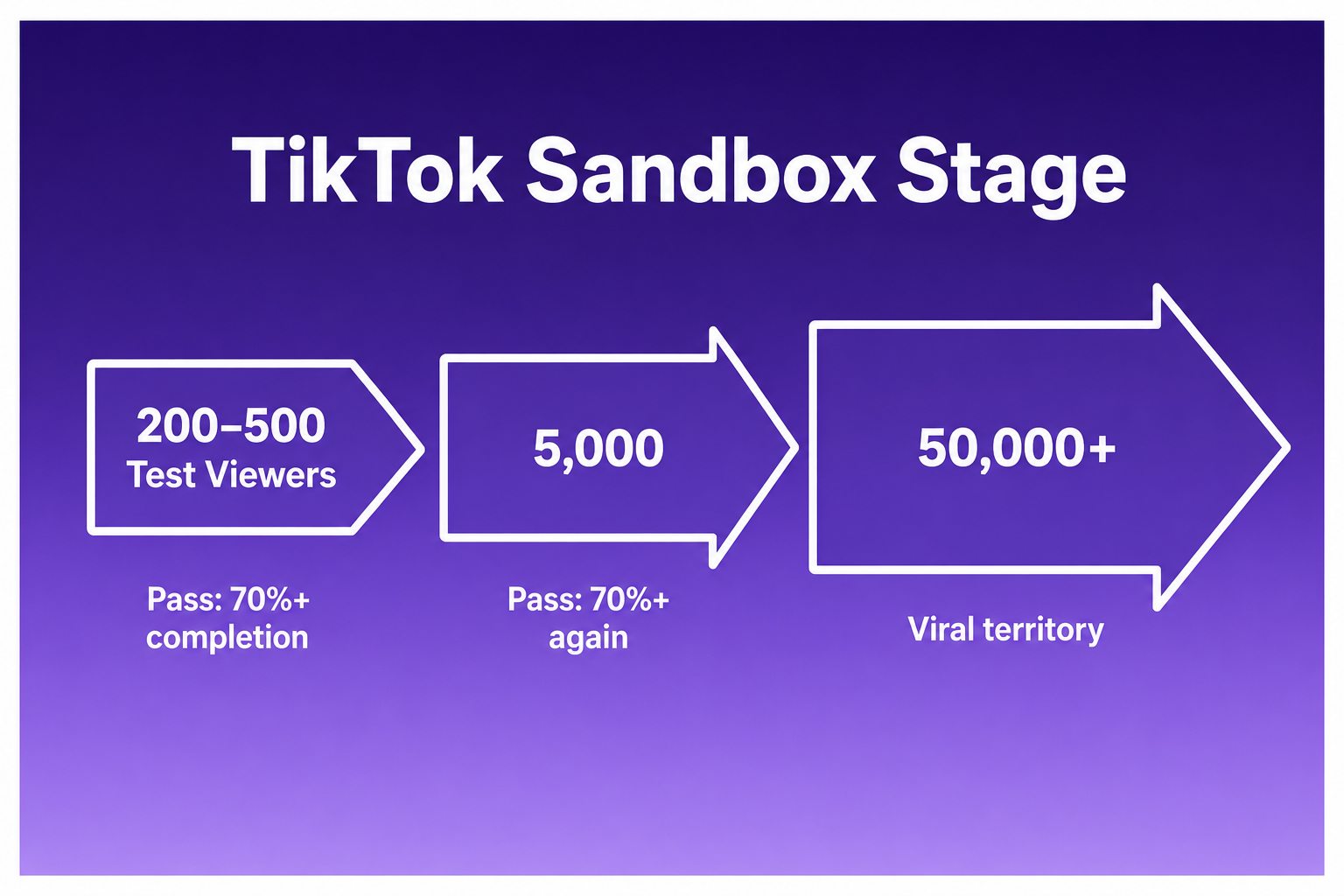
New TikTok accounts enter a "sandbox stage" that lasts roughly 2-4 weeks. During this period, every video you post gets shown to a test pool of just 200-500 initial viewers. TikTok is evaluating your content before deciding whether you deserve wider distribution. Think of it like a restaurant soft launch: the neighborhood gets to try your food before the Yelp reviewers show up.
If those first 200-500 viewers respond well, specifically with high completion rates and shares, TikTok pushes the video to a larger pool. That pool might be 5,000 viewers, then 50,000, then beyond. Each step up requires passing the completion rate threshold again. This is why your first 10 videos aren't really about going viral. They're about teaching the algorithm what your content is.
What counts as "responding well"? Aim for 70%+ completion rate on those early videos. That's the viral threshold. Post 15-30 second videos during the sandbox stage. They're physically easier for viewers to complete, which boosts your completion percentage automatically.
What Happens If You Fail the Sandbox Test?
Your video stays small. That's it. It doesn't hurt future videos. Each new post gets its own fresh test pool of 200-500 viewers. One bad video doesn't tank your account. The algorithm treats every video independently, which is actually great news for beginners who are still figuring out their style.
Posting Frequency During the Sandbox Stage
Post 1-3 times per day during your first 2-4 weeks. More data points help the algorithm understand your content category faster. Don't ghost for a week and come back with a single video. Consistency signals commitment to the platform, and TikTok rewards accounts that post regularly with slightly better initial distribution.
New TikTok accounts enter a sandbox stage lasting 2-4 weeks, during which each video reaches an initial test pool of 200-500 viewers. Achieving a 70%+ video completion rate in this test pool is the threshold that triggers broader For You Page distribution.
Before You Post: What to Set Up First
Profile optimization before your first video matters more than most guides admit. TikTok's algorithm uses profile category signals to decide which initial test pool to send your first video to. If your profile doesn't clearly communicate your niche, the algorithm sends your video to a random audience, and random audiences don't convert to followers. That's a waste of your sandbox test.
The 5-Minute Profile Setup
Start with a clear username that includes your niche or name. "CookingWithSarah" beats "xXsarah2026Xx" every time. Write a bio that tells people exactly what they'll get if they follow you. One sentence, no fluff. "Daily 60-second recipes for busy people" is perfect. "Content creator, dog mom, coffee lover" tells the algorithm nothing useful.
Switch to a Creator Account (it's free). Creator accounts get access to TikTok Analytics, the Creator Marketplace, and expanded audio libraries. You want those analytics from day one so you can track completion rates on every video.
Pick One Niche and Stick to It
The algorithm needs to know who to show your content to. If you post cooking videos, then fitness tips, then comedy skits, TikTok gets confused and shows your videos to mismatched audiences. Pick one specific niche. Not "fitness," but "5-minute home workouts for beginners." Specificity helps the algorithm find your exact audience faster.
| Factor | 15-30 Second Videos | 60-180 Second Videos |
|---|---|---|
| Completion Rate | Much easier to achieve 70%+ | Harder, requires strong storytelling |
| Algorithm Boost | Strong early-stage signal | Better for established accounts |
| Sandbox Stage | Best choice (weeks 1-4) | Risky for new accounts |
| Rewatch Potential | High (loop effect) | Lower rewatch rate |
| Best For | Beginners, growth phase | Education, storytelling niches |
The 5-Step Formula for Going Viral With 0 Followers
The hook is everything. TikTok's own data confirms that your video must grab attention within the first 1-3 seconds or the platform stops distributing it. That's not a metaphor. If viewers scroll away in the first three seconds, the algorithm reads that as a signal your content isn't worth showing to more people. One weak opening kills the whole video.
Here are the five steps, in order of importance.
Step 1: Write a Hook That Stops the Scroll
Your first sentence on screen or in your voiceover is your entire audition. Use pattern interrupts: "Nobody tells beginners this about TikTok." Use curiosity gaps: "I gained 10K followers doing the thing everyone says doesn't work." Use specific numbers: "I tested 47 hooks and here's the one that worked." Need help? The TikTok Hook Generator builds scroll-stopping openers based on your niche.
Step 2: Use Trending Audio (But Smartly)
Trending sounds get a distribution boost because TikTok wants to spread trending content. But don't just slap a trending song on an unrelated video. Match the audio's vibe to your content. TikTok's Creative Center shows you which sounds are trending in your region right now.
Step 3: Post at the Right Times
Timing affects how many active users are in your initial test pool. Later.com's 2026 analysis found Tuesday through Friday, 9am-12pm and 7pm-9pm local time, are the highest-engagement windows. Schedule your early posts to hit those windows. Don't post at 2am and wonder why nobody saw it.
Step 4: Write a Caption That Drives Comments
Comments are TikTok's second-highest algorithmic signal, after completion rate. A caption ending in a question drives comment volume. "Which one would you pick? A or B?" works. "Drop your answer below" works. The goal is to start a thread that keeps people on your video page longer, which TikTok also tracks.
Step 5: Use 3-5 Targeted Hashtags
The "30 hashtags" strategy is dead. TikTok's algorithm now uses hashtags as category labels, not SEO spam tools. Use 3-5 hashtags: one broad niche tag, one more specific tag, and one or two trending tags. The TikTok Hashtag Generator finds the right mix for any niche automatically.
TikTok's algorithm requires video hooks to capture attention within the first 1-3 seconds or distribution halts. Combined with Later.com's 2026 finding that peak posting windows run Tuesday-Friday at 9am-12pm and 7pm-9pm local time, timing and opening seconds are the two highest-leverage variables for beginners with zero followers.
How Long Does It Actually Take to Go Viral?
Honest answer: it's not instant, and anyone saying otherwise is selling something. Most accounts that successfully go viral started seeing significant traction at the 3-6 month mark of consistent posting. That's the real timeline. There are exceptions, where a first video blows up, but planning around the exception is how you end up disappointed and quitting in week two.
Here's a more realistic breakdown by milestone. In weeks one through four (the sandbox stage), you're building data. The algorithm is learning what you make. Expect 200-2,000 views per video. That's normal. Don't panic.
Months two and three are when your first real spikes usually happen. If you've been consistent, the algorithm has you categorized. Your niche audience starts finding you. One video might break 10,000 views. That's the signal to double down on whatever made that video work.
Months four through six is when the compounding effect kicks in. Each new video gets a slightly larger initial test pool because your account has a track record. Follower growth accelerates. The accounts you see blowing up with millions of views? Most of them have 200 videos posted that nobody watched. You just didn't see those.
Troubleshooting: Why You're Getting 0 Views
Getting 0 views isn't random. There are specific, fixable causes, and each one has a direct solution. Small accounts under 5K followers average 4.86% engagement (Social Insider, 2026), which means the audience potential is genuinely there for new creators. Zero views almost always means a technical or setup problem, not a content quality problem.
Reason 1: Your Account Is Under Review
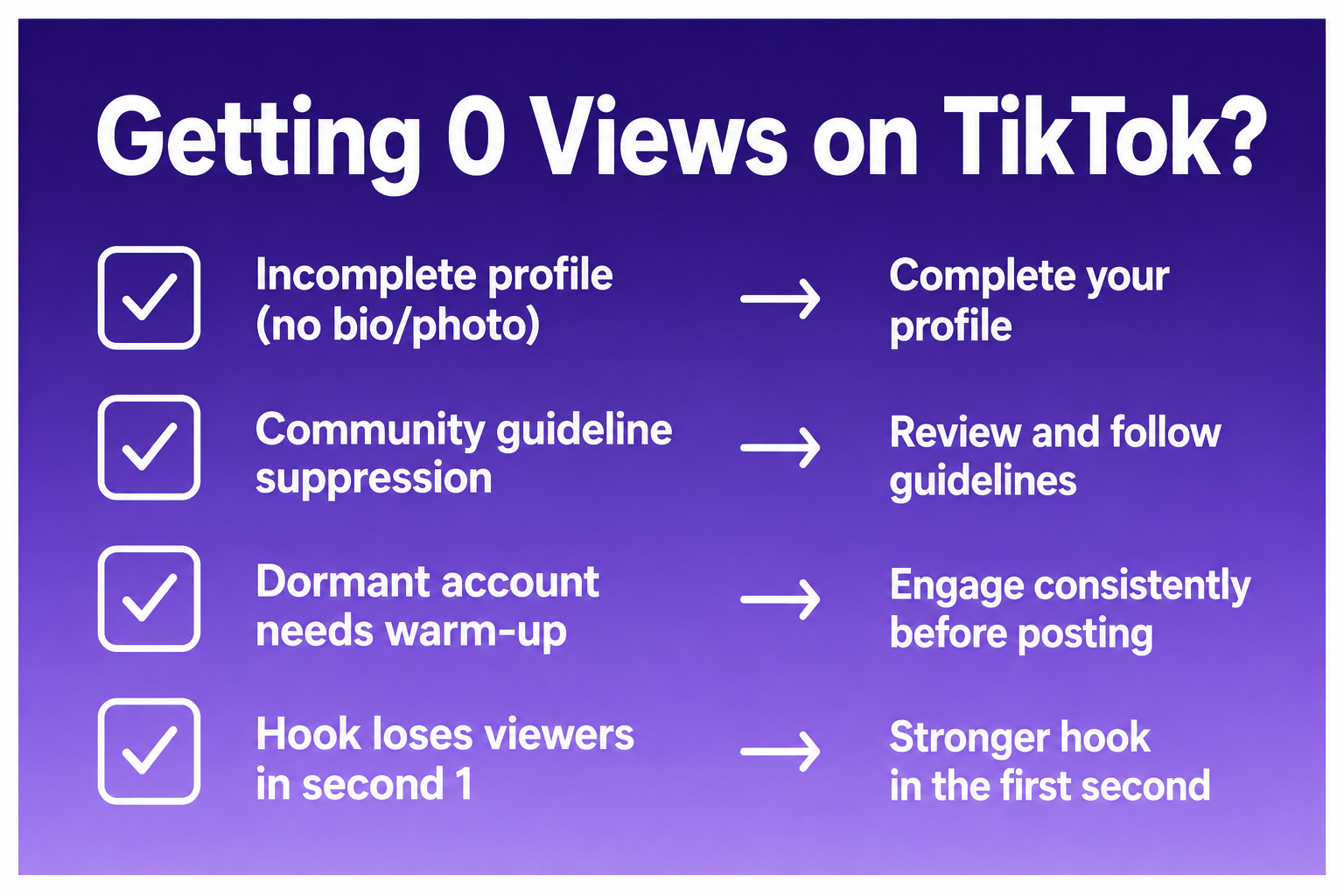
New accounts sometimes go through a brief review period, especially if you jumped straight into posting without filling out your profile. Fix: complete your profile, add a profile photo, and write a bio. Then wait 24 hours before posting again. A bare-bones account with no bio reads as a spam account to TikTok's automated systems.
Reason 2: Your Video Violated Community Guidelines
Even minor violations suppress distribution hard. This includes copyrighted music (use TikTok's free commercial audio library instead), anything flagged as misleading, and content that's borderline for TikTok's age-based filters. Check your TikTok inbox for any warnings. One suppressed video doesn't kill your account, but ignoring the pattern will.
Reason 3: You're Posting to a New or Dormant Account
If your account sat inactive for more than a few weeks before you started posting seriously, TikTok treats it similarly to a brand-new account. The sandbox stage restarts. Think of it as your account needing to warm up again. Post daily for two weeks. The test pool will re-engage.
Reason 4: Your Hook Isn't Working
Check your analytics for "Average Watch Time" on each video. If it's under 20% of the video length, people are leaving in the first second. That's a hook problem, not a content problem. Rewrite your opening. Try a bold visual instead of talking. Try text on screen before you appear. The TikTok Script Generator can help structure your video openings around proven hook formats.
Small TikTok accounts with under 5,000 followers achieve an average 4.86% engagement rate, nearly 2.4 times higher than accounts with 100,000+ followers at 2.06%, according to Social Insider's 2026 study of 70 million+ posts. Zero views on a new account almost always signals a fixable technical issue rather than poor content quality.
Use These Free Tools to Execute Faster
The gap between knowing the strategy and actually executing it is where most beginners stall. TikTok success in 2026 comes down to volume and iteration: posting consistently and adjusting based on what works. Free tools cut the time it takes to go from idea to published video, which means you can post more often without burning out.
- TikTok Hook Generator - Generate scroll-stopping first lines for any niche in seconds
- TikTok Viral Idea Generator - Find content formats proven to perform in your specific niche
- TikTok Hashtag Generator - Get 3-5 targeted hashtags instead of spamming 30 generic ones
- TikTok Script Generator - Write full video scripts with built-in hook, body, and CTA structure
For more hook formats with working examples across different niches, our TikTok hook examples guide covers 9 hook types in detail — including the specific structures that drove the highest completion rates in 2026.
Frequently Asked Questions
Can you go viral on TikTok with 0 followers?
Yes. TikTok's algorithm distributes content based on video performance, not follower count. Every new video enters a test pool of 200-500 viewers regardless of your account size. Small accounts under 5K followers average 4.86% engagement, nearly double larger accounts, according to Social Insider 2026. The playing field is genuinely level for beginners here.
How many views is considered viral on TikTok?
Most creators consider 500,000 views or more to be viral on TikTok. For a new account with 0 followers, hitting 10,000-50,000 views on a single video is a meaningful viral moment. That kind of performance typically triggers significant follower growth and signals the algorithm to give your future content broader initial distribution.
How long does it take to go viral on TikTok as a beginner?
Most accounts that go viral started seeing real traction at 3-6 months of consistent daily posting. The sandbox stage lasts 2-4 weeks, during which each video reaches only 200-500 initial viewers. Posting 1-3 videos per day during that period speeds up the algorithm's learning curve considerably. Patience here isn't optional.
What video length is best for going viral on TikTok with 0 followers?
15-30 second videos are best for new accounts. The 70% completion rate threshold is far easier to hit on shorter content. A 15-second video watched fully scores better than a 2-minute video watched halfway. Once your account has traction and a follower history behind it, you can safely experiment with longer formats.
Why is my TikTok getting 0 views?
Common causes include an incomplete profile (no bio or photo), a video that triggered community guidelines suppression, a dormant account status, or a hook that loses viewers in the first second. Check your TikTok inbox for warnings, complete your profile fully, and study your average watch time in TikTok Analytics to find the exact problem.
Start With the Sandbox, Not the Spotlight
Zero followers isn't a handicap on TikTok. It's a starting position, and every creator you admire started in the exact same spot. The algorithm doesn't care about your follower count. It cares whether real people watch your video to the end. That's actually the fairest deal you'll ever get from a social media platform, so take advantage of it.
Your action plan is straightforward. Set up your profile correctly, pick one specific niche, post 15-30 second videos consistently during the sandbox stage, nail your hook in the first three seconds, and post during peak windows on Tuesday through Friday. Check your completion rates weekly and adjust what isn't working. Use the free TikTok tools to cut your production time in half.
Once your first videos get traction and followers start coming in, your strategy needs to shift. Our TikTok growth guide for small accounts covers exactly how to turn early momentum into a consistent path to 1,000 followers: niche locking, posting schedules, and escaping the view jail plateau.
Most people who want to go viral on TikTok never post a second video. The competition is, genuinely, that thin. Show up consistently for 90 days and you'll be in the top 10% of TikTok creators by effort alone. The algorithm will notice. Your future followers are out there spending 95 minutes a day on the app (DataReportal, 2026), waiting for someone exactly like you to show up on their For You Page.
The only thing standing between zero followers and your first viral video is the post button. Go hit it.